Damian Elwes is a British painter born in 1960 who lives in L.A. From a family of famous portrait painters, his grandfather being Queen Elizabeth’s favourite, he studied in Harvard because he was good at maths but learned playwriting. In the early 1980s, Elwes moved to New York, where he met Keith Haring who encouraged him to start painting, and became an early exponent of graffiti. From 1992–2000,  Damian Elwes lived in southern Colombia in a house that he built overlooking a rainforest. There he created four vast, interactive paintings which viewers can walk around inside. His work now focuses on re-creating the studios of famous artists (Picasso, Matisse, Yayoi Kusama, Alex Katz, Keith Haring, Basquiat) through his deep research in documentation and historical records.

https://www.instagram.com/damianelwes/
https://www.damianelwes.com/

#DamianElwes #Art #AskAGO #ArtGoesON
https://www.instagram.com/askartgoeson/

Recorded on May 5th 2020

Iván Navarro évoque dans cette dernière partie sa passion d’adolescent pour les concerts clandestins qui à l’époque étaient à la fois l’expression de la liberté artistique et une réponse au pouvoir en place. L’artiste pousse sa passion de collectionneur de bootleg et de vinyls jusqu’à lancer son propre label, Hueso Records, sur lequel il signe un groupe emblématique de cette période, les Pinochet Boys.
Il explique ensuite comment il a développé sa connaissance du Light Art au delà des images qu’il connaissait d’artistes comme Dan Flavin ou Keith Sonnier. Puis à quel point les voyages et sa découverte d’artistes tels que Meyer Vaisman ont pu élargir ses horizons et lui donner confiance en lui en tant qu’artiste.

Pour Iván Navarro, toute passion doit à un certain moment être abordée et approfondie sérieusement, c’est la clé pour en faire un art.


In this last part, Iván Navarro talks about his passion as a teenager for underground concerts which at the time were both an expression of artistic freedom and a response to the ruling power. The artist pushes his passion for bootleg and vinyl up to launch his own label, Hueso Records, on which he signs an emblematic group of this period, the Pinochet Boys.
He then explains how he developed his knowledge of Light Art beyond the images he knew of artists like Dan Flavin or Keith Sonnier. Then how much traveling and discovering artists like Meyer Vaisman would broaden his horizons and give him self-confidence as an artist.
For Iván Navarro, all passion must at some point be approached and deepened seriously, this is the key to making it an art.

Iván Navarro a passé son enfance et son adolescence sous la dictature chilienne à son apogée. Au cours de ces années, les Chiliens ont découvert que des personnes avaient été assassinées et torturées et ont commencé à protester contre le pouvoir en place. En réponse, pour maintenir l’ordre et contrôler la population, le gouvernement a créé des pannes d’électricité; plongeant les gens dans l’obscurité et l’insécurité. Navarro raconte comment il a vécu ces situations, et nous comprenons comment la lumière et la privation de lumière ont eu une influence majeure sur son travail. L’artiste parle également de deux de ses mentors: Eduardo Vilches, un ancien élève de Josef Albers, qui lui a enseigné la théorie des couleurs et Eugenio Dittborn dont il a appris à être un artiste professionnel en étant son assistant de studio. Son aventure artistique se poursuivra à New York où il fera ses premières expositions majeures après 7 ans de travail en temps que restaurateur de meubles anciens.


Iván Navarro spent his childhood and his teenage years under the Chilean dictatorship at its peak. During those years, Chileans discovered that people were murdered and tortured and began to protest against the power in place. In response, to maintain order and control the population, the government created blackouts ; plunging people into darkness and insecurity without electricity. Navarro tells how he dealt with those issues, and we understand how light and privation of light was a major influence on his work. The artist also speaks about two of his mentors : Eduardo Vilches, a former student of Josef Albers, who taught him theory of color and Eugenio Dittborn from whom he learned how to be a professional artist by being his studio assistant. His artistic adventure will continue in New York where he will make his first major exhibitions after 7 years of work as an antiques restorer.

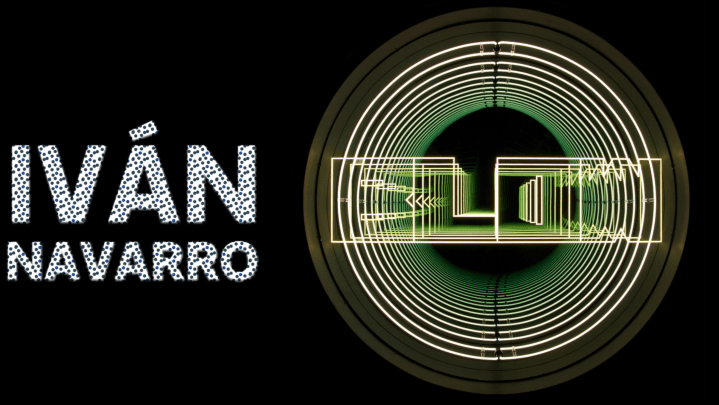
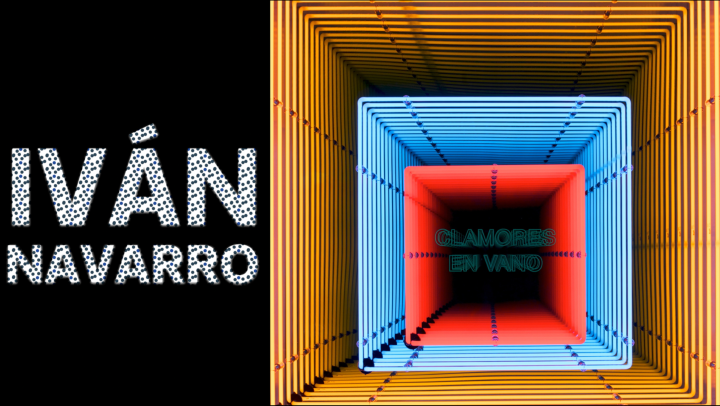
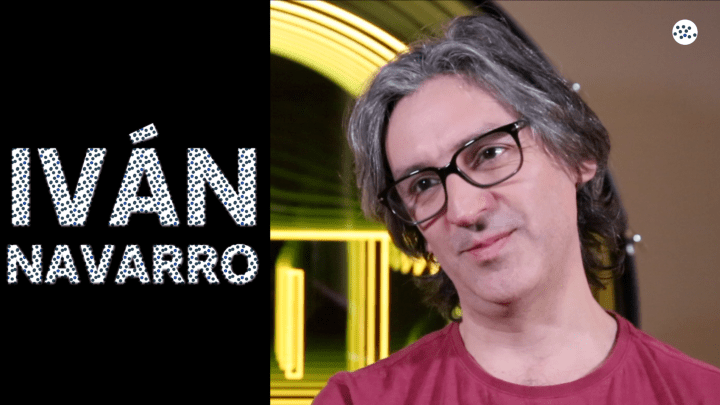
Iván Navarro est un artiste chilien connu pour son travail conceptuel et son utilisation des lampes fluorescentes. Issu d’une famille engagée politiquement et soutenant Salvador Allende, il est né en 1972 à peine un an avant le coup d’État d’Augusto Pinochet en 1973. Dès lors, son père Mario Navarro professeur de graphisme et également connu sous le nom de Nakor, caricaturiste politique, perd son travail et arrête de faire des caricatures. Cette situation a d’abord incité Iván Navarro à ne pas s’engager dans une voie artistique. Attiré par l’artisanat et désireux de travailler de ses mains, Navarro souhaite apprendre la menuiserie. Le manque d’établissements d’enseignement dans ce domaine le contraint à choisir une formation en scénographie mais ses examens le mèneront à étudier l’art.


Iván Navarro is a Chilean artist known for his conceptual work and his use of fluorescent lights. From a family committed politically and supporting Salvador Allende, he was born in 1972 just a year before Augusto Pinochet’s coup d’état in 1973. From then, his father Mario Navarro a professor of graphic design and also know as Nakor a political cartoonist, loses his job and censors himself from doing caricatures. This situation first influenced Iván Navarro not to pursue an artistic path. Attracted by craft and wanting to work with his hands, Navarro’s wishes to learn carpentry. The lack of educational establishments in that field constrains him to choose an education in set design but through his exams he will end up studying art.

Georgia Russell tells us about her relationship to her work and the long path she went through before getting any recognition. Art is something that you must do for yourself without looking for fame. And to keep going it has to enrich you and to give you pleasure. If art is doing you good, then it should be enough to satisfy you because you can’t expect things to happen. A career in art is not easy, there is more and more competition, and a young artist needs perseverance.
Georgia Russell’s art evolved through the years and she keeps challenging herself every time she feels too much in a comfort zone. She hopes that in those difficult time her art is able to give pleasure or joy to the audience. This is the best recognition she can wish for.

More about Georgia Russell (books) :
Georgia Russell : http://bit.ly/2Ksc2R1
Georgia Russell – Time and Tide exhibition : http://bit.ly/2O2v4hF
Georgia Russell – Paintings : http://bit.ly/2O6yb8n


Georgia Russell nous parle de sa relation avec son travail et du long chemin qu’elle a parcouru avant d’être reconnue. L’art est quelque chose que vous devez faire pour vous-même sans rechercher la gloire. Et pour continuer, il doit vous enrichir et vous donner du plaisir. Si l’art vous fait du bien, alors cela devrait suffire à vous satisfaire car vous ne pouvez pas vous attendre à ce que les choses vous arrivent. Une carrière dans l’art n’est pas facile, il y a de plus en plus de concurrence et un jeune artiste a besoin de persévérance.
L’art de Georgia Russell a évolué au fil des ans et elle ne cesse de se remettre en question chaque fois qu’elle se sent trop dans une zone de confort. Elle espère qu’en ces temps difficiles son art est capable de donner du plaisir ou de la joie au public. C’est la meilleure reconnaissance qu’elle puisse souhaiter.