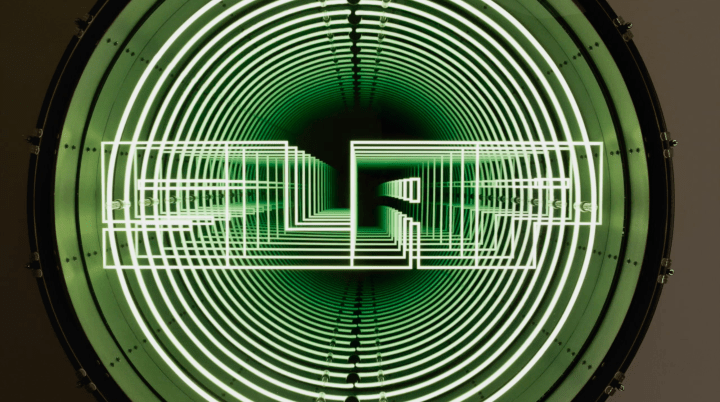
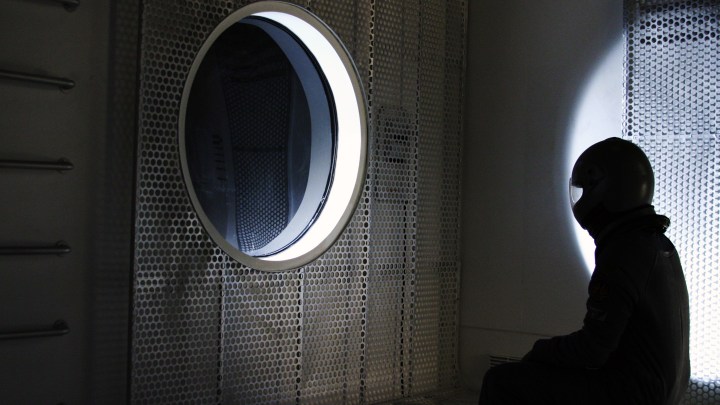
L’artiste chilien Iván Navarro présente sa dernière exposition à Paris. FANFARE se tient à la galerie Daniel Templon du 1 mars au 7 mai 2017.
Passionné de musique depuis son adolescence, il assistait à des concerts clandestins sous le régime de Pinochet. Ces actes de rébellion sont pour lui la plus belle manifestation de résistance. Il se met à collectionner les enregistrements de l’époque et produira plus tard certains de ces groupes undergrounds avec son label Hueso Records. Dans Fanfare, Navarro présente un ensemble d’installations avec des tambours, dont la première pièce “Drums” a été réalisée en 2009. L’exposition bat au son de chants révolutionnaires d’amérique latine et d’ailleurs dont l’artiste, connu pour son art fait de néon et de lampes fluorescentes, collectionne les vinyles.
Chilean artist Iván Navarro presents his latest exhibition in Paris. FANFARE is held at the Daniel Templon Gallery from March 1 to May 7, 2017.
Passionate about music since his teenage years, he attended clandestine concerts under the Pinochet regime. These acts of rebellion are for him the most beautiful manifestation of resistance. He began collecting recordings of that time and later produced some of these underground bands with his label Hueso Records. In Fanfare, Navarro presents a set of installations with drums, the first of which “Drums” was made in 2009. The exhibition beats to the sound of revolutionary songs from Latin America and elsewhere whose artist, known for his Neon and fluorescent lamps art, collects vinyl.
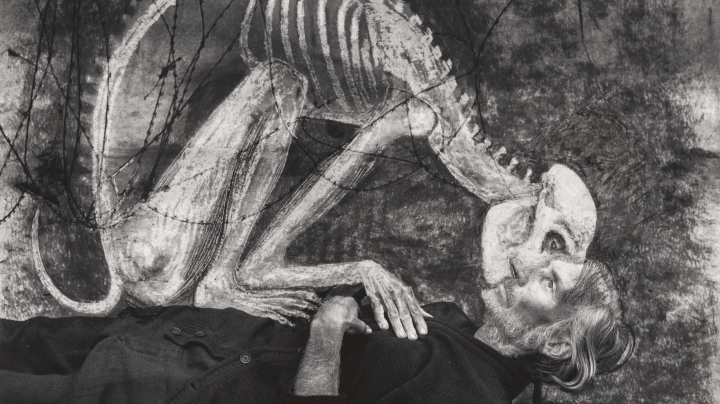
Ces deux artistes sur leur support respectif traitent depuis toujours des rapports entre l’homme et l’animal. Dans cette exposition, Roger Ballen et Hans Lemmen collaborent pour faire fusionner leur travail. Lemmen réinterprète les photos de Ballen en y ajoutant des dessins et peintures tandis que Ballen découpe les dessin de Lemmen pour les coller sur ses photos. Il en résulte un travail unique et inédit. L’exposition débute par une installation créée par les deux artistes et se termine par un documentaire de Saskia Vredeveld sur cette collaboration.
These two artists on their respective supports have always dealt with the relationship between man and animal. In this exhibition, Roger Ballen and Hans Lemmen collaborate to merge their work. Lemmen reinterprets the pictures of Ballen by adding drawings and paintings while Ballen cut out the drawings of Lemmen to paste them in his photos. The result is a unique and unpublished work. The exhibition begins with an installation created by the two artists and ends with a documentary by Saskia Vredeveld on this collaboration.
Claire Morgan décrit dans cette dernière partie son processus dans la réalisation de ses dessins qui sont pour elle un moyen d’expression alternatif. Elle explique ses doutes, sa détermination et les difficultés qu’elle peut croiser dans l’exercice de son travail. L’artiste termine sur la genèse et l’évolution de ses idées et de ses envies qui constituent à la fois de nouveaux défis et de nouveaux horizons.
Le dessin “était pour moi une façon pratique d’expliquer des idées ou de créer une atmosphère. Ça expliquait mieux que des mots ce qu’une idée pouvait donner avant de la réaliser.”
“Parfois avec une sculpture, en particulier quand elle est suspendue, le niveau de précision que je peux atteindre ou la forme n’est pas forcément équivalente à ce qu’on peut faire avec un dessin. C’est donc une approche différente d’une même idée.”
“J’ai fait un échange universitaire de 3 mois en Hollande. Alors qu’à Newcastle quoi que vous fassiez, c’était nul. Aux Pays bas tout était fantastique. J’ai réalisé que tout ça était très subjectif, que ça ne traduit pas forcément la réalité. Ça m’a permis de me dire que je devais faire simplement ce que je voulais.”
“Je crois que j’ai toujours été déterminée. Je voulais faire ça. Donc lorsque j’ai été diplômée, je n’ai pas attendu qu’on me propose une exposition. J’ai décidé d’organiser ma propre exposition.”
“J’ai commencé à faire des peintures. C’est à la fois passionnant et effrayant à faire. Car ce n’est pas quelque chose que je connais autant que la sculpture.”
“Aujourd’hui je maîtrise mon travail en sculpture, c’est donc devenu pour moi confortable ; peut-être trop facile. Mais ça m’ouvre aussi des portes car je peux faire des choses plus complexes etc…”
“Mes derniers dessins et peintures sont totalement en dehors de ma zone de confort. C’est pour cette raison que c’est passionnant.”
Claire Morgan describes in this last part her process in the realization of her drawings which are for her an alternative means of expression. She explains her doubts, her determination and the difficulties she can encounter in the performance of her work. The artist ends with the genesis and the evolution of her ideas and desires which constitute new challenges and new horizons.
Drawing “was a way of practicality of just explaining ideas that I had or tried to create an atmosphere. Or explain more than words could what what an idea might be before it’s actually made.”
“Sometimes with a sculpture, especially a suspended thing, the level of precision that I could achieve or the form isn’t necessarily the same as what you could do with a drawing. So it’s sort of like a different avenue of the same idea.”
“I did an exchange in Holland for 3 month. And whereas in Newcastle no matter what you made, basically they said it was shit. And in Holland no matter what you made, they said it was amazing. So I realised actually that this is just somebody’s opinion, it doesn’t necessarily reflect reality. It enabled me to see that I should just do what I think.”
“I think I’ve just always been determined. This is what I’m gonna do. S whenever I graduated from uni, I didn’t even wait for someone to offer me an exhibition. I just decided I’m going to organize my own exhibition.”
“I started working on some paintings. I find it very scary but very exciting to do that. Just because I don’t know it like with my sculpture work.”
“As far as the things that I’m making now, actually I know the process of it inside out so there is an aspect of it where it’s kind of easy, but maybe too easy. But then also that opens up different doors because I can make things that are more complex and so on…”
“The drawings and the paintings that I’ve been making recently are definitely outside my comfort zone. Their quite exciting because of that actually.”
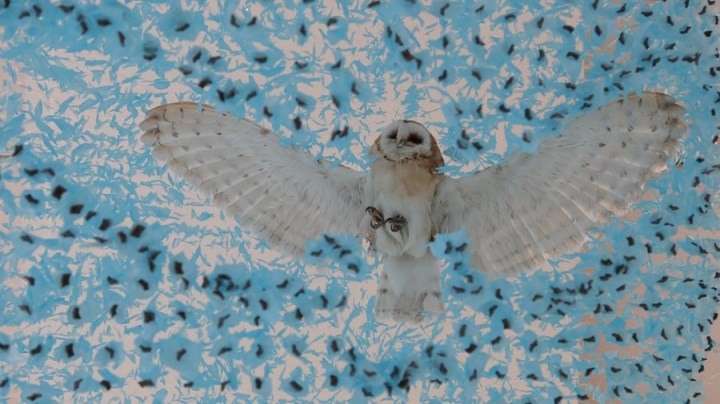
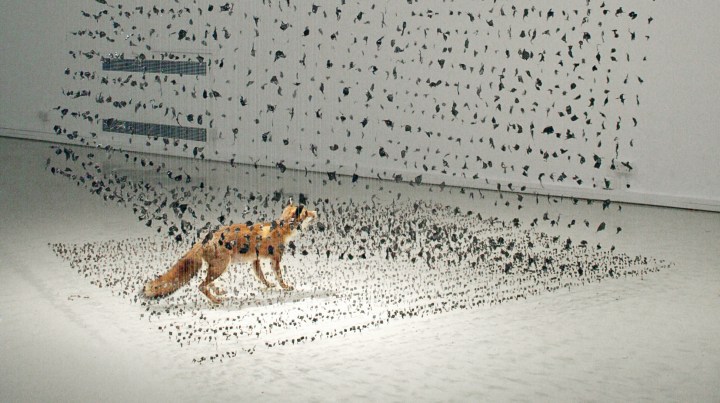
Dans cette deuxième partie Claire Morgan explique sa philosophie et comment, peu à peu, elle a construit son style unique. La sculpture n’était pas son intérêt premier mais c’est sa créativité qui l’y a poussée. Elle décrit l’importance qu’elle donne à la nature, à la mort et à l’emprise du temps. Enfin on découvre comment elle en est venue à la taxidermie et à l’usage du plastique dans ses sculptures.
“Quand j’ai pensé à mon entrée à l’université, j’ai songé à faire une école de mode.”
“J’utilisais toujours des matières organiques quand j’étais à l’université.”
“Ça m’apparaissait comme logique que les animaux, une fois morts, deviennent un matériau organique.”
“Je crois que je posais des difficultés [à l’université]. Je suis très féministe, très politique et assez agressive à cet égard. Et quand j’ai commencé à faire des sculptures suspendues c’était pour que ça fasse peur et que ce soit désagréable pour le spectateur.”
“La taxidermie a été la suite logique de ma démarche.”
“Pendant que je cherchais ces animaux ou n’importe quelle matière organique intéressante, je n’arrêtais pas de trouver des déchets plastiques qui venaient des fermes.”
“Ce que produit la nature est bien plus beau que n’importe quelle chose que l’homme peut créer.”
In this second part Claire Morgan explains her philosophy and how, little by little, she has built her unique style. The sculpture was not her primary interest but her creativity drove her to that . She describes the importance she gives to nature, death and the effect of time. Finally we discover how she came to taxidermy and the use of plastic in her sculptures.
“Whenever I started Uni… I had this idea at school about possibly fashion design.”
“I was always using organic materials when I was at university.”
“It just seems like a logical thing to me that animals, once they’re dead, it’s an organic material.”
“I think I was quite difficult [at university]. I’m very feminist, I’m very political and really quite aggressive actually. And when I started to make suspended things it’s because I wanted to make some things that were scary and unpleasant for the viewer.”
“Taxidermy came out as a natural progression.”
“While I was looking for these animals or looking for any kind of interesting organic stuff I just kept finding plastic from farming waste.”
“Things that occur naturally are just much more beautiful that anything that we can create anyway.”
Apichatpong Weerasethakul nous explique dans cette dernière partie les doutes dans sa carrière, même après avoir gagné le Prix du jury au Festival de Cannes. Il nous explique ensuite comment il est arrivé à l’art vidéo, qui finalement a pris plus de volume que le cinéma. Avant d’évoquer son prochain projet de film qui pour la première fois se déroulera hors de son pays, il donne des conseils sur comment trouver sa voie en tant qu’artiste.
“Même lorsque je suis allé à Cannes pour la deuxième fois avec Tropical Malady, en 2004, je me demandais si je faisais un vrai métier.”
“En fait je fais plus d’art vidéo que de cinéma mais les gens ne le savent pas.”
“Je pense qu’aussi bien pour le cinéma que pour l’art vidéo, ça correspond à ce que je veux exprimer, symboliquement ou pas, sur la vie en Thaïlande.”
“J’ai essayé de trouver la frontière entre réalité et fiction. En fait il faut trouver la réponse à cette question. Evidemment en cherchant cette réponse vous regardez le travail d’autres artistes, ce qu’ils ont fait. Et là, ce que je recommande, et que je fais moi-même, c’est d’intégrer son expérience personnelle dans son travail. Et à force d’intégrer votre propre expérience, l’influence de vos artistes modèles diminuera. S’installera alors une relation authentique entre votre expérience et ce que vous aimez réellement. Ça nous permet de comprendre quelle chose nous manquerait le plus si elle n’existait pas.”
“Mon cinéma est en train d’atteindre ses limites en Thaïlande. Je commence à craindre la censure qui affecte ma créativité et ma prise de décision.”
Apichatpong Weerasethakul explains in this last part the doubts in his career, even after winning the Jury Prize in the Cannes Film Festival. He then explains how he came to video art, which ultimately took more volume than cinema. Before discussing his next film project which for the first time will take place outside his country, he gives advice on how to find his way as an artist.
“Even when I went to Cannes for the second time for Tropical Malady, in 2004, I still ask myself : is this a real profession?”
“In fact I do video art more than cinema but people don’t know that.”
“I think for both cinema and vidéo art, it’s pretty much what I want to say, either symbolically or not, about living in thailand.”
“I tried to find the line between reality and fiction. You just have to find the path to this question. Obviously seeking the answer, you look at the work of other artists, what they did. And here’s what I recommend, and I’m doing myself, is to integrate personal experience in your work. And through integrating your own experience, the importance of your reference artists will decrease. And you will feel the genuine relationship between your experience and what you really love. It allows us to understand what thing would miss most if it did not exist.”
“My cinema starts to reach its limit in Thailand. I start to feel that censorship affects my creativity and decision making.”