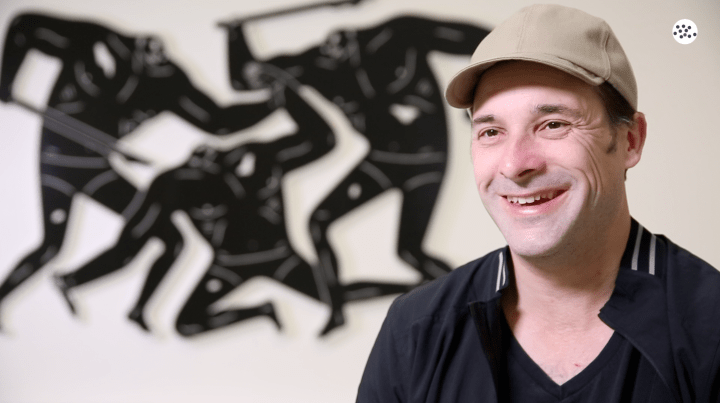
Cleon Petersonest un artiste américain né à Seattle. Ses parents ont une vie de bohème et sont visités par beaucoup d’artistes qui entourent Cleon et son frère Leigh Ledare, futur photographe. Enfant, il souffre d’asthme et vit entre l’hôpital et son foyer. Il tue le temps, même le peu qu’il passe à l’école, en dessinant. Étant talentueux et passionné, il déménage à Brooklyn dans une école où il a obtenu une bourse.
Cleon Peterson is an american artist born in Seattle. His parents live a bohemian lifestyle and are visited by a lot of artists that surround Cleon and his brother Leigh Ledare a future photographer. As a child he suffers from asthma and lives between the hospital and his home. He kills time, even the little one he spends at school, by drawing. Being talented and passionate about it he moves to Brooklyn in a school where he got a scholarship.
Alexandre Bavard termine son entretien en évoquant son engagement d’artiste. Être un jeune artiste est pour lui central dans la société d’aujourd’hui ; il s’agit pour lui d’un combat. Ce sont les doutes et les aléas rencontrés par l’artiste qui le construisent. Pour Alexandre Bavard, il n’y a pas d’artiste sans remise en question, sans volonté de connaissance. Mais pour l’artiste c’est aussi la curiosité et le perpétuel renouvellement par la curiosité.
Alexandre Bavard ends his talk by evoking his commitment as an artist. Being a young artist is central to him in today’s society; It is a fight for him. The doubts and uncertainties encountered by the artist shape him. For Alexandre Bavard, there is no artist without questioning, without a will of knowledge. But for the artist it is also curiosity and perpetual renewal through curiosity.
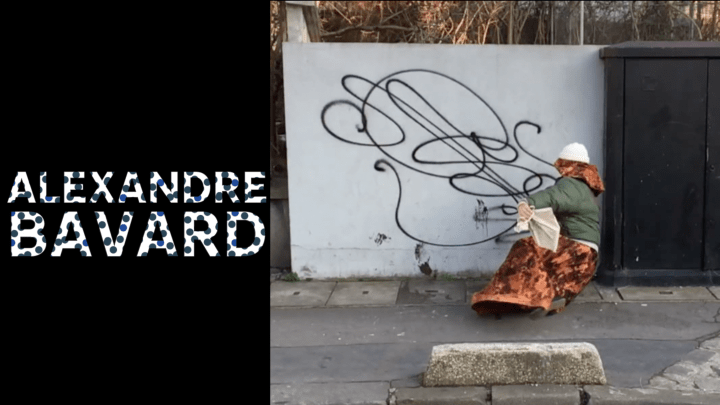
Alexandre Bavard a un point de vu radical sur le graffiti et son esprit. Dans cette deuxième partie, il explique son rapport à l’illégalité, donne sa définition du graffiti et livre les origines de son style très particulier. Enfin, pour celui qui considère que le tag appartient à la rue, il pose la problématique du street art exposé en galerie et en institution. C’est en créant un système de notation du mouvement qu’il est arrivé à consigner la gestuelle de son graffiti. La partition ainsi créée correspond à une chorégraphie effectuée par des danseurs lors de performances.
Alexandre Bavard has a radical point of view on graffiti and its spirit. In this second part, he explains his relationship to illegality, gives his definition of graffiti and delivers the origins of his very particular style. Finally, for the one who considers that the tag belongs to the street, it poses the problematic of street art exposed in gallery and in institution. By creating a dance notation system he managed to record the gesture of his graffiti. The score thus created corresponds to a choreography performed by dancers during performances.
Alexandre Bavard est un jeune artiste parisien né en 1987. Issu du graffiti dans lequel évolue sous le blase de MOSA, il est aussi diplômé de l’école Boulle et des Beaux Arts de Lyon. Baigné dans la pop-culture des années 70 à aujourd’hui ; les jeux vidéo, les films, internet et le rap forment ses principales influences. Ce sont l’école de la rue, du tag mais aussi ses rencontres aux Beaux Arts et sa curiosité pour les voyages et les expériences artistiques qui en font aujourd’hui un artiste multiple.
Alexandre Bavard is a young Parisian artist born in 1987. Having a background in graffiti under the nickname of MOSA, he is also a graduate of the École Boulle and the School of Fine Arts of Lyons. Immersed in pop-culture from the 70s to the present; video games, movies, internet and rap form its main influences. It is the school of the street, the tag but also his meetings at the School of Fine Arts and his curiosity for travel and artistic experiences that make him a multiple artist today.
L’artiste américain Tristan Eaton présente sa première exposition solo en Europe. Uprise est présentée à la Galerie Itinerrance du 9 juin au 8 juillet 2017.
Tristan Eaton est né en L.A en 1978, il a découvert le graffiti quand il était adolescent à Londres où ses parents avaient déménagés. Issu du skate, il a également été introduit au comics et aux illustrateurs subversifs britanniques qui sont toujours une influence dans son travail d’aujourd’hui.
Uprise est une histoire visuelle de protestation et de résistance. À l’ère de Donald Trump, du racisme croissant, de la xénophobie et des violations flagrantes des droits de l’homme dans le monde entier, Tristan Eaton espère un monde meilleur et au besoin de jeter hors du pouvoir ceux qui ne le méritent pas. Uprise est un regard sur l’histoire humaine qui montre comment les impuissants ont renversé les puissants et comment le petit peuple peut vaincre le tyran avec une protestation pacifique et le pouvoir des idées.
American artistTristan Eaton presents his first solo exhibition in Europe. UPRISE is shown at Galerie Itinerrance from June 9th to July 8th 2017.
Tristan Eaton was born in L.A in 1978, he discovered graffiti when he was a teenager in London where his parents moved. Having a background in skate he was also introduced to comic books and to the subversive British illustrators that are still an influence in his work today.
Uprise is a visual history of protest and resistance. In the age of Donald Trump, rising racism and xenophobia and blatant human rights violations across the globe, Tristan Eaton hopes for a better world and a need to throw out of power those who don’t deserve it. Uprise is a look back on human history that shows how the powerless have risen to topple the powerful and how the little man can vanquish tyrants with peaceful protest and the power of ideas.



 Our Choices