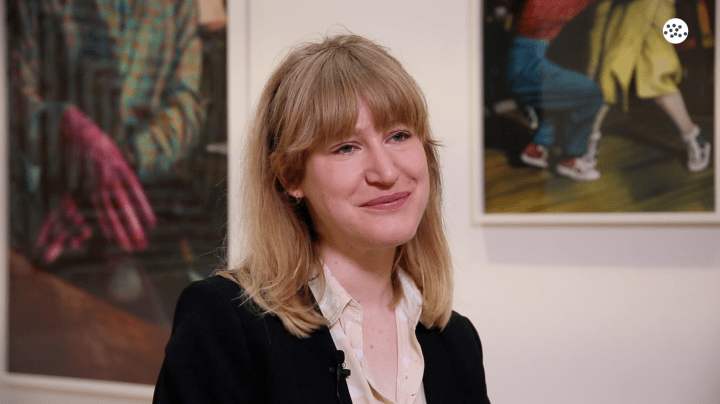
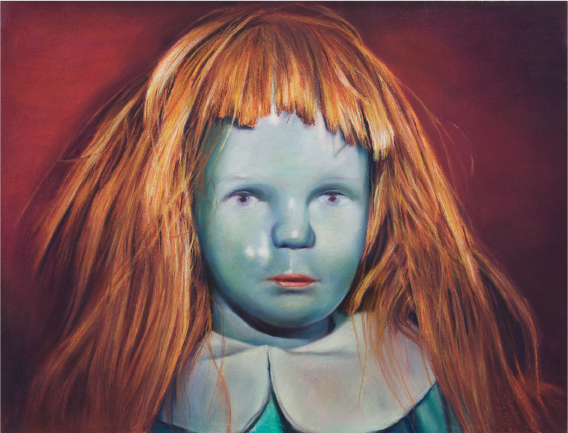
Née en Allemagne du Nord, Katharina Ziemke agrandi dans une famille qui aimait les lettres. Son père, éditeur, lui a donné le goût de la littérature et de la peinture classique russe dont elle réalise des copies encore enfant. Attirée par la philosophie qu’elle découvre en apprenant le latin, elle se rend à Paris et subit un choc culturel. Poussée par la famille qui l’héberge et les souvenirs de sa grand-mère artiste ; elle s’inscrit à l’école des Beaux Arts.

“Ma grand-mère était artiste. Elle était peintre et elle faisait cette technique à la cire que j’utilise aujourd’hui.”

“Je crois que j’ai été influencé par la luminosité de la cire.”

“Mon père a étudié le russe et nous avions beaucoup de livres sur la peinture russe. J’ai fait des copies de ces peintures. D’abord à l’aquarelle et après à l’huile.”

“C’était très étranger pour moi de voir des artistes contemporains. Mais c’était en même temps fascinant parce que je ne comprenais pas ce que c’était. Il y avait une sorte d’énigme assez fascinante.”

“Je me souviens d’oeuvres de Thomas Schütte que j’aime beaucoup maintenant. […] Je crois que ça a pu m’influencer même si je l’ai pas compris à l’époque.”

Au lycée, “Mon cours d’art n’était pas très intéressant. J’étais un peu déçue car je voulais m’exprimer mais il y avait toujours un sujet  auquel il fallait répondre. Ça m’ennuyait.”

“J’ai pensé que je pouvais devenir professeur de latin.”

“Ils m’ont dit “Tu devrais faire les Beaux Arts.” Je crois que je n’aurais jamais fait cette démarche de moi-même.”


Born in northern Germany, Katharina Ziemke was raised by a family that loved literature. His father, as a publisher, gave her the taste for literature and Russian classical painting that she used to copy as a teenager. Attracted by philosophy that she discovered by learning Latin, she went to Paris had a cultural shock. Driven by the family that hosts her and the memories of her grandmother who was an artist; she enrolled in the National School of Fine Arts.

“My grandmother was an artist. She was a painter and she would the same wax technique I’m using myself today”

“I think I was influenced by the light of the wax.”

“My father studied Russian and we had a lot of books about Russian paintings. And I copied those paintings, first in watercolor then in oil.”

“It was very unfamiliar for me to see contemporary artists. But it was captivating at the same time because I did not really understand what it was. It was like a fascinating riddle.”

“I remember artworks from Thomas Schütte that I really like now. […] I think it inspired me even if I didn’t understand it at the time.”

In high school “art class was not interesting. I was disappointed because I wanted to express myself and there was always a framework and precise questions to answer to. It bored me “

“I thought I might teach Latin.”

“They told me “You should go to the National School of Fine Arts.” I think that without this advice I wouldn’t have thought about it myself.”

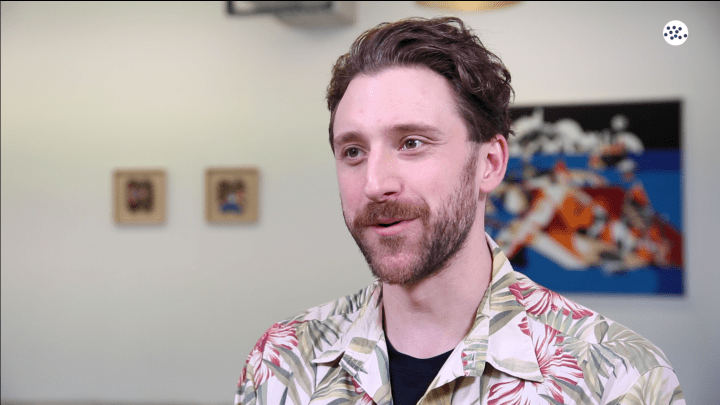
James Reka explique l’origine de son style qu’il a développé pendant plus de 15 ans notamment grâce à ses influences classiques. Connu pour son Street art mais venant du graffiti, il nous donne son avis sur ces deux mouvements entre lesquels il peut y avoir des frictions.

“Mon outil de prédilection est la bombe aérosol. J’ai développé mon style avec la manière dont j’aime utiliser la peinture en spray.”

“Ce n’est pas arrivé en une nuit. J’ai commencé comme tout débutant en m’inspirant du travail d’autres artistes. Puis ensuite on le fait à sa manière.”

“Néanmoins mon inspiration ne vient pas toujours du travail des autres. Elle provient aussi de mon quotidien. Je peux marcher dans la rue et voir une belle texture sur un mur et m’en inspirer. J’ai toujours un appareil photo sur moi et je prends beaucoup de clichés”

“Ce qui m’attirait c’était la rue, son côté brut et l’énergie qui s’en dégageait.”

“Le street artistes doivent s’exprimer selon les règles du graffiti. Il y a beaucoup des règles non dites aussi. C’est étrangement très structuré même si c’est une forme d’expression très libre.”

“J’ai beaucoup de chance de pouvoir dire que je suis un artiste et de pouvoir vivre de mon art.”


James Reka explains the origins of his style that he developed for over 15 years particularly thanks to its classical influences. Known for his Street art but coming from the graffiti world, he gives us his opinion on these two movements between which there can be friction.

“My favourite tool is the spray can. I’ve developed my style around the way I like to use spray paint.”

“It didn’t happen overnight, I started somewhere. Often when you begin, you take a lot of inspiration from other artists and you make you’re making it to your own.”

“However some of the inspiration I get is not looking at other people’s artwork. It’s my day to day life. I walk down the street and see a beautiful texture on a wall and I get inspiration from that. I always take my camera everywhere and I take photos of everything.”

“What attracted me was the streets, the rawness and the energy.”

“Street artists need to play by graffiti rules. There are a lot of unspoken rules as well. And there’s a lot of structure even though there is such a free expression.”

“I’m very lucky to be able to say that I’m an artist and I can survive of my artwork.”

James Reka ou RekaOne, est un street artiste australien. Issu d’une famille de créatifs, il est très vite attiré par le graffiti qu’il découvre en prenant le train chaque jour pour se rendre à l’école. Il explique la naissance de sa passion, notamment animée par son goût du risque, et son évolution vers la quête d’un style unique.

“J’ai grandi près d’une voie ferrée. Je prenais le train tous les jours pour aller à l’école et sur les voies je voyais passer toutes ces couleurs en mouvement.”

“J’aimais l’idée que ces types sortaient la nuit pour faire des oeuvres illégalement. Ils risquaient tout pour leur passion, pour être créatifs.”

“Même si j’avais un très bon professeur d’art, les autres enseignants me faisaient comprendre qu’il était difficile de vivre de son art.”

“Quand j’ai débuté le street art, je n’avais pas l’intention d’exposer dans des galeries. Je faisais tout gratuitement, dans la rue, par passion, par goût du risque. Je fuyais la police…”

“Le monde du graffiti m’a appris qu’il était important de développer son propre style. Que c’était plus important que le contenu.”


James Reka a.k.a. RekaOne, is an Australian street artist. Coming from a creative family, he’s quickly attracted by graffiti that he discovered by taking the train each day to get to school. He explains the birth of his passion, especially driven by his taste for risk, and its evolution to the quest for a unique style.

“I grew up near a train line. It was my first exposure to graffiti. I would catch the train everyday to go to school and on the train lines I would see all those colours and movement.”

“I liked the idea that these guys were going out at night doing illegal work basically. They were risking everything for their passion, to be creative.”

“Even though I had a very good art teacher, the other teachers tried to make me realise that it wasn’t that it is very difficult to make money out of your art.”

“Originally when I started, I had no intentions of being a gallery artist. I was doing everything for free, on the streets, for the passion, for the risk. Running from the police…”

“One of the elements that I’ve learnt from the graffiti world is that it is important to pursue style as the most important think over content.”

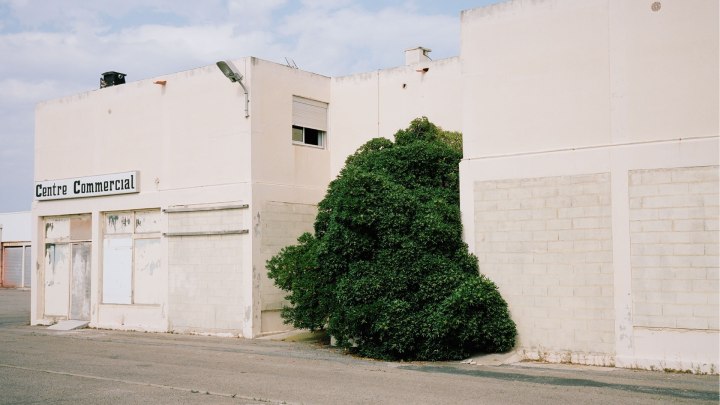
A travers sa propre expérience, Shane Lynam nous donne son point de vue sur la façon d’appréhender la photographie d’art quand on débute et que l’on souhaite en vivre. Lui qui a quitté son job pour se consacrer à la photo, il nous explique la façon dont il a géré sa carrière, sa méthode de travail et comment il envisage son avenir.

“Pour la plupart quand on trouve ce qu’on veut faire, c’est un formidable moment dans sa vie. Mais pour moi c’est une pression à accomplir et de savoir comment je vais y arriver. C’est une chose qui peut-être stressante.”

“Quand on débute dans la photographie, ça prend un moment avant de gagner de l’argent.”

“Pour moi le plus important est de progresser tout le temps. Ce n’est pas forcément faire la meilleure photo mais lui donner plus de sens et de force.”

“Je pense que je ferai toujours de la photo. Quoiqu’il advienne je me vois enchaîner les projets. Que les gens les voient ou pas.”

P.M.


Through his own experience, Shane Lynam gives us his views on how to comprehend art photography when you begin and make a living from it. He who left his job to devote himself to photography,explains how he managed his career, his working method and how he sees his future.

“I guess people talk about once you figure out what you want to do, it’s a great moment in your life. But there’s almost a pressure then to realise it and how you’re going to go about making it all happen. It can almost be a kind of a stress.”

“Photography, especially when you’re starting out, takes a while before you start making money.”

“With me the most important is just improving all the time. Not necessarily making the best photo ever just make the work more meaningful and stronger.”

“I think I’ll always make work for the rest of my life. No matter what happens, I see myself making projects after projects whether anyone sees it.”

P.M.

Philippe Baudelocque est un artiste français né en 1974 dans une famille de musiciens ouverte à la culture avec un père artiste animalier. Jeune adolecsent au moment où le hip-hop et le graffiti explosent en France, il fait ses premiers pas artistiques en taguant son pseudo, Fusion, lors de ses explorations urbaines. C’est en allant à New York où il rencontres les pionniers du street art qu’il réalise que cette culture n’est pas en phase avec sa philosophie. Il conserve la passion des dessins sur grande surface, des lettrages et de l’énergie de cette discipline pour se l’approprier et l’interpréter à sa façon.

C’est en 2009 qu’il tombe face à un mur noir, rue du pont aux choux, et qu’il décide de faire son premier dessin à la craie. L’animal cosmique qu’il réalise est alors photographié et fait le tour de la blogosphère, il a trouvé son style. Si les animaux sont très représentatif de son travail, c’est à la nature au sens large qu’il s’intéresse. La nature est pour lui notre univers, le cosmos et toutes les interactions qui en résultent.

“Quand le graffiti est arrivé, ce qui m’a beaucoup intéressé c’est l’énergie. C’était tellement différent de tout ce que je voyais.”

“Je participe à cette forme d’art mais à ma manière. C’est à dire que ce n’est pas spécialement le coté vandalisme de la chose qui m’intéressait. Je retenais juste l’expérimentation des lettres et des formes dans des endroits désaffectés.”

A propos de ses premiers dessins à la craie :
“Je n’étais pas du tout dans le sens à penser à tout. Pas du tout. C’est vraiment le prix. Avec un paquet de 10 ou 12 craie on peut faire un grand mur comme ça. J’étais pragmatique, c’était vraiment ça.”

“C’est là que j’ai pris conscience que je me sentais bien en faisant ça. Je ne marche sur aucun pied. Je suis chez moi. Je suis chez moi, tranquille, je parle de choses qui m’intéressent profondément et qui me touchent.”

“Je doute encore, de tout. Mais fondamentalement j’ai l’information. Quand je me connecte vraiment avec mon coeur, avec moi tout entier. C’est cet état où tout est calme, tout est limpide, où il n’y a strictement aucune pensée.”

P.M.


Philippe Baudelocque is a French artist born in 1974 into a family of musicians open to culture with a naturalist father. Young adolecsent when hip-hop and graffiti shot up in France, he made his first artistic steps by tagging his nickname, Fusion, during his urban explorations. When he went to New York, he encountered the pioneers of street art and realized that this culture was not in line with his philosophy. He retained the passion of drawing on large area, lettering and of the energy of this discipline and interpreted it in his own way.

It was in 2009 that he came across a black wall, rue du Pont aux Choux, and decided to make his first drawing with chalk. The cosmic animal he realized is then photographed and went around the blogosphere, he then found his style. If animals are very representative of his work, he is interested in nature in its wide sense. Nature is for him our universe, the cosmos and all the interactions that result from it.

“When I discovered graffiti what I really enjoyed was the energy. It was so different than what I was used to.”

“I get involved in the graffiti movement. But in my own way. Because I was not interested in the vandalism aspect of it. I was more into experimenting letters and shapes, in closed down places.”

About his first drawings with chalk:
“At that time I wasn’t thinking up everything. Not at all. It was really a matter of price.With a pack of 10 or 12 chalks, I could draw on such a big wall. The idea was as simple as that, pragmatic.”

“This is when I’ve been aware of how good I was feeling doing this. I wasn’t stepping on anyone foot. I feel at home. I’m in my house, quiet. I’m on something deeply interesting that moves me.”

“I still have doubts, on everything… But fundamentally, deep inside me I have the information. When I’m connected with my heart, my inner self. It is a state when everything is quiet and crystal clear. When you don’t think of anything.”

P.M.