
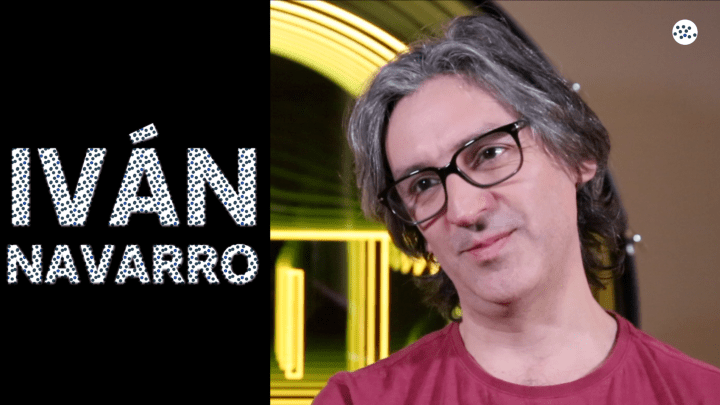
Iván Navarro est un artiste chilien connu pour son travail conceptuel et son utilisation des lampes fluorescentes. Issu d’une famille engagée politiquement et soutenant Salvador Allende, il est né en 1972 à peine un an avant le coup d’État d’Augusto Pinochet en 1973. Dès lors, son père Mario Navarro professeur de graphisme et également connu sous le nom de Nakor, caricaturiste politique, perd son travail et arrête de faire des caricatures. Cette situation a d’abord incité Iván Navarro à ne pas s’engager dans une voie artistique. Attiré par l’artisanat et désireux de travailler de ses mains, Navarro souhaite apprendre la menuiserie. Le manque d’établissements d’enseignement dans ce domaine le contraint à choisir une formation en scénographie mais ses examens le mèneront à étudier l’art.


Iván Navarro is a Chilean artist known for his conceptual work and his use of fluorescent lights. From a family committed politically and supporting Salvador Allende, he was born in 1972 just a year before Augusto Pinochet’s coup d’état in 1973. From then, his father Mario Navarro a professor of graphic design and also know as Nakor a political cartoonist, loses his job and censors himself from doing caricatures. This situation first influenced Iván Navarro not to pursue an artistic path. Attracted by craft and wanting to work with his hands, Navarro’s wishes to learn carpentry. The lack of educational establishments in that field constrains him to choose an education in set design but through his exams he will end up studying art.

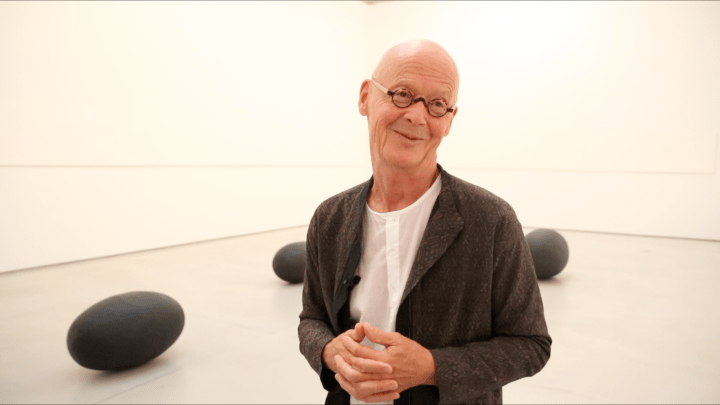

Wolfgang Laib évoque l’étendue de sa vision de l’art qui pour lui n’est pas simplement une question de couleurs ou de peinture. Inspiré par des artistes comme Brancusi ou Jakob Brackle et par la philosophie asiatique, son art aborde l’équilibre entre le temporel et l’intemporel, entre le fragile et l’éternel. Pour Laib rien ne remplace l’expérience de la vie qu’il faut embrasser corps et âme. C’est ce qu’il conseille aux jeunes artistes qui pour lui ne doivent pas s’enfermer en école d’art.


Wolfgang Laib evokes the extent of his vision of art which for him is not simply a question of colors or painting. Inspired by artists like Brancusi or Jakob Brackle and by Asian philosophy, his art approaches the balance between the temporal and the timeless, the fragile and the eternal. For Laib nothing replaces the experience of life that must be embraced body and soul. This is what he advises to young artists who for him should not be caught up in art schools.


Wolfgang Laib est un artiste dont la pratique est inextricable de son mode de vie modeste et hermétique. Fils de docteur, il entame des études de médecine. Passionné de philosophie asiatique, ses parents lui font découvrir l’art tantrique et l’emmènent en Inde. C’est après ce voyage qu’il réalise son premier oeuf en granit noir, un Brahmanda, et qu’il décide qu’il sera artiste et non docteur.


Wolfgang Laib is an artist whose practice is inextricable in his modest and hermetic way of life. Son of doctor, he began studying medicine. Passionate about Asian philosophy, his parents made him discover tantric art and took him to India. It is after this journey that he realizes its first egg in black granite, a Brahmanda, and decides that he will become an artist and not a doctor.