
Nathaniel Mary Quinn is an American contemporary artist who explores themes of identity, resilience, and the human experience. His latest exhibition, “The Forging Years,” reflects on his upbringing in Chicago and the transformative power of art in his life. Quinn’s distinctive style combines portraiture and abstraction to create visually striking compositions that evoke a powerful sense of emotion and vulnerability. Gestalt theory plays a significant role in his artistic practice, as he aims to evoke emotions, provoke introspection, and foster a deeper understanding of the self. At the core of his work is the message of persistence and resilience.
Nathaniel Mary Quinn’s unique style of combining portraiture and abstraction creates a sense of intrigue and emotion that draws the viewer in. His use of gestalt theory is a testament to his understanding of the human psyche and his ability to provoke introspection. “The Forging Years” exhibition is a touching reflection on how art has helped him navigate his life’s challenges. Through his artwork, Quinn encourages viewers to reflect on their own experiences and find strength in their own resilience. His work serves as a reminder that despite life’s struggles, we can persist and overcome.
nathaniel mary quinn
Nathaniel Mary Quinn

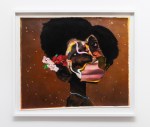

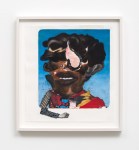
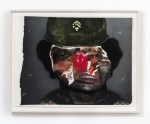
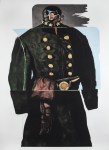
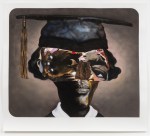

Lorsqu’on regarde le parcours de Nathaniel Mary Quinn, on pense immédiatement à une fiction, un conte moderne, urbain. Cet artiste américain a grandi à Chicago dans l’un des pires ghettos des États Unis. Une famille illettrée, un père accro au jeu, une mère paralysée après plusieurs accidents vasculaires cérébraux et une fratrie composée d’alcooliques et de toxicomanes. Au sein du plus grand complexe de logements sociaux du pays dont 95% des habitants vivent avec moins de 5 000 $ par an, il croise les pires truands, est confronté aux trafics, aux vols et aux crimes quotidiens (jusqu’à 28 morts en un week-end). Sa mère le laisse dessiner sur les murs de l’appartement, son père retire les gommes de ses crayons et lui explique “qu’il ne faut jamais effacer. Toute trace a une signification. Si tu fais une erreur, utilise la pour la mettre à profit dans ce que tu réalises.”
A quinze ans, alors qu’il a obtenu une bourse d’étude dans un collège huppé de l’Indiana, sa mère décède. Lorsqu’il revient chez lui à Chicago pour les obsèques, il découvre un appartement vide ; le reste de sa famille es parti sans laisser de trace. C’est à ce moment là qu’il prend la décision de survivre, d’échapper à un destin sombre qui semble pourtant déjà écrit. Il se plonge dans les études, passant les vacances scolaires dans les familles aisées de ses camarades de classe qui veulent bien l’héberger alors qu’il n’a pas de toit. Quelques années plus tard il est diplômé en art de l’université de New York.
Aujourd’hui ses portraits sont ceux des fantômes du passé, il explique : “Je marche dans la rue et j’ai des visions. Je ne les note jamais car je ne les oublie jamais. Mes visions sont souvent des souvenirs qui continuent de m’habiter, la manifestation d’une marque indélébile faite par mes expériences.” Nathaniel Mary Quinn nous plonge dans l’univers de son enfance, peuplé d’un bestiaire féroce, intense, effrayant et parfois grotesque. Une jungle qu’il fallait soit subir, soit affronter en jouant un personnage cohérent. “On se bat pour convaincre les spectateurs d’une vie apparemment homogène, mais en nous il y a une tension, une rupture et des éléments en contradiction. C’est notre état brut. C’est ce que je veux peindre.” Ses peintures sont le témoignage de la souffrance et de la tristesse qui ne le quittent jamais et de la liberté qu’il a gagné en s’acceptant. Il trouve aussi son inspiration dans les photographies, les films, la musique… il adore regarder des vidéos sur youtube où des producteurs de hip-hop sont en studio en pleine création : “vous sentez l’existence d’une énergie sans effort, où une pensée excessive ne fait pas partie de l’équation.” L’énergie de ses portraits est là, le trouble qu’ils provoquent est bien présent. Cet artiste semble sortir tout droit du poème de Tupac Shakur : The Rose that Grew from Concrete.
P.M.
Looking at the path of Nathaniel Mary Quinn, you immediately think of a fiction, a modern, urban tale. This American artist grew up in Chicago in one of the worst ghettos in the US. An illiterate family, a father addicted to gambling, a mother paralyzed after several strokes and siblings composed of alcoholics and drug addicts. In the largest public housing complex in the country of which 95% live on less than $ 5,000 a year, he crosses the worst mobsters, is confronted with trafficking, thefts and daily crimes (up to 28 deaths in a weekend). His mother let him draw on the walls of the apartment, his father would take the erasers off the pencils and told him never to erase. “Every mark has meaning. If you make a mistake, make use of that mistake and turn it into something that can work for you.”
At fifteen, when he was awarded a scholarship in an exclusive college in Indiana, his mother died. When he returned to Chicago for the funeral, he discovered an empty flat; the rest of the family left without a trace. It was at this time that he made the decision to survive, to escape from a dark fate that seemed already written. He immersed himself in studies, spent the school holidays in the wealthy families of his classmates who hosted him as he had no home. A few years later he graduated from the NYU with a MFA.
Today his portraits are those of the ghosts of the past, he explains: “Walking down the street, I get a vision. I never write them down because I never forget them. My visions are often memories I continue to hold on to, the manifestation of an indelible mark made on me by certain experiences.” Nathaniel Mary Quinn takes us into the world of his childhood populated by ferocious, intense, scary and sometimes grotesque beasts. A jungle he had to either undergo or face playing a coherent character. “We fight to convince spectators of what appears to be a seamless existence, but inside is tension, rupture and things that don’t quite fit. That is the raw you. I want to paint that.” His paintings are records of the suffering and sadness that never left him and the liberty that he won by self-acceptance. He also finds inspiration in photographs, movies, music … he loves watching videos on youtube where hip-hop producers are in their studio creating music : “you sense the existence of effortless energy, where excessive thought is not, or was not, a part of the equation.” The energy of his portraits is there, the distress they cause is present. This artist seems to come straight from Tupac Shakur’s poem : The Rose That Grew from Concrete.
P.M.

 Our Choices