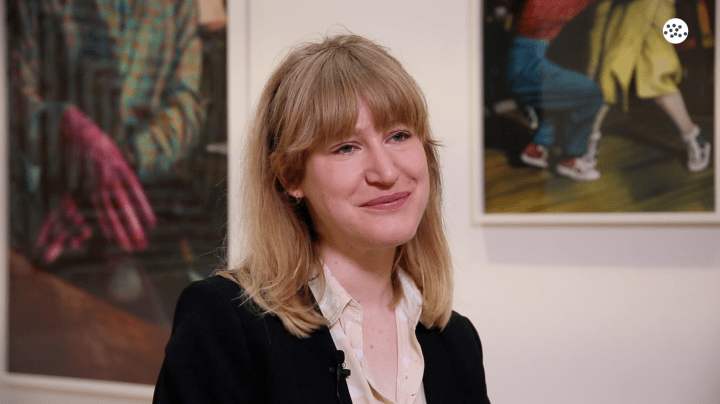
Née en Allemagne du Nord, Katharina Ziemke agrandi dans une famille qui aimait les lettres. Son père, éditeur, lui a donné le goût de la littérature et de la peinture classique russe dont elle réalise des copies encore enfant. Attirée par la philosophie qu’elle découvre en apprenant le latin, elle se rend à Paris et subit un choc culturel. Poussée par la famille qui l’héberge et les souvenirs de sa grand-mère artiste ; elle s’inscrit à l’école des Beaux Arts.

“Ma grand-mère était artiste. Elle était peintre et elle faisait cette technique à la cire que j’utilise aujourd’hui.”

“Je crois que j’ai été influencé par la luminosité de la cire.”

“Mon père a étudié le russe et nous avions beaucoup de livres sur la peinture russe. J’ai fait des copies de ces peintures. D’abord à l’aquarelle et après à l’huile.”

“C’était très étranger pour moi de voir des artistes contemporains. Mais c’était en même temps fascinant parce que je ne comprenais pas ce que c’était. Il y avait une sorte d’énigme assez fascinante.”

“Je me souviens d’oeuvres de Thomas Schütte que j’aime beaucoup maintenant. […] Je crois que ça a pu m’influencer même si je l’ai pas compris à l’époque.”

Au lycée, “Mon cours d’art n’était pas très intéressant. J’étais un peu déçue car je voulais m’exprimer mais il y avait toujours un sujet  auquel il fallait répondre. Ça m’ennuyait.”

“J’ai pensé que je pouvais devenir professeur de latin.”

“Ils m’ont dit “Tu devrais faire les Beaux Arts.” Je crois que je n’aurais jamais fait cette démarche de moi-même.”


Born in northern Germany, Katharina Ziemke was raised by a family that loved literature. His father, as a publisher, gave her the taste for literature and Russian classical painting that she used to copy as a teenager. Attracted by philosophy that she discovered by learning Latin, she went to Paris had a cultural shock. Driven by the family that hosts her and the memories of her grandmother who was an artist; she enrolled in the National School of Fine Arts.

“My grandmother was an artist. She was a painter and she would the same wax technique I’m using myself today”

“I think I was influenced by the light of the wax.”

“My father studied Russian and we had a lot of books about Russian paintings. And I copied those paintings, first in watercolor then in oil.”

“It was very unfamiliar for me to see contemporary artists. But it was captivating at the same time because I did not really understand what it was. It was like a fascinating riddle.”

“I remember artworks from Thomas Schütte that I really like now. […] I think it inspired me even if I didn’t understand it at the time.”

In high school “art class was not interesting. I was disappointed because I wanted to express myself and there was always a framework and precise questions to answer to. It bored me “

“I thought I might teach Latin.”

“They told me “You should go to the National School of Fine Arts.” I think that without this advice I wouldn’t have thought about it myself.”

Sam Leach a débuté sa carrière dans les finances publiques au bureau des impôts australien dans lequel il a travaillé près de 12 ans. Diplômé en économie, mais dessinateur amateur, c’est à l’âge de 21 ans qu’il a eu sa première révélation artistique, lors d’un voyage en Europe. Là, il découvre les oeuvres de Gerhard Richter ou encore Gunther Forg qui lui donnent envie faire de l’art contemporain et de créer son propre style. Il prend alors des cours de perfectionnement et, petit à petit, la peinture devient son activité principale quand il commence à en vivre. Il n’en oublie pas sa vie antérieure car sa peinture s’intéresse aussi à l’impact de l’économie sur la société. Marqué par la peinture flamande du 17ème siècle, notamment poussée par le capitalisme d’entreprise, il reproduit lui-même des paysages peints à l’époque.

“J’ai trouvé un lien fascinant entre les halls d’entreprises et la peinture architecturale hollandaise au 17ème siècle. Le fait que cette période corresponde à l’essor du capitalisme m’a beaucoup interpellé car j’y ai vu de nombreux impacts esthétiques. Je me suis demandé à quel point les images produites à cette époque reflétaient la façon dont on structurait notre société aujourd’hui.”

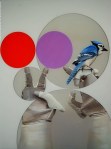
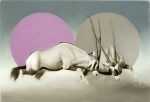
L’influence de la science sur la société l’intéresse également beaucoup. Les disques ou traits figurants sur ses oeuvres nous font penser à des infographies économiques ou à des atomes sans relief, sans émotion.

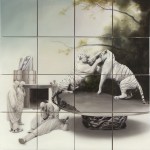
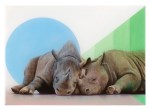
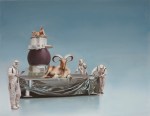
Les animaux, parfaitement représentés sur ses peintures, sont un peu à notre image, à la fois impactés par les dérives du capitalisme et parfois oubliés dans les bouleversements créés par les progrès de la science.

“Je veux être capable de lire une certaine émotion ou une intention chez les animaux, mais qu’elles soient propre à ce qu’est l’animal. Les qui me servent de modèle sont habituellement dans des zoos, ou empaillés ou en tout cas prennent un pose qui sous entend qu’il a déjà eu une interaction avec l’homme.”

Que ce soit dans le portrait ou les paysages, Sam Leach excelle. Il a remporté en 2010 les prix Archibald et Wynne qui récompensent respectivement ces deux formes de représentations picturales.

Sa première monographie a été publiée en 2015

P.M.


Sam Leach began his career in the Australian Tax Office where he worked nearly 12 years. A graduate in economics, but drawing as a hobbyist, it is at the age of 21  that he had his first artistic revelation, while traveling in Europe. There, he discovered the works of Gerhard Richter or Gunther Forg that made him want to make contemporary art and create his own style. He then took advanced courses and gradually painting became his main activity when he started to make a living from it. His former life left a mark though as we see in his paintings an interest in the impact of the economy on society. Marked by Flemish painting of the 17th century, particularly driven by corporate capitalism at that time, he reproduces landscapes painted at the time.

“I came across a fascinating link between corporate foyers and the architecture paintings made in the Netherlands in the 17th century, and the fact that this period corresponded with the rise of corporate capitalism really resonated with me because I could see aesthetic echoes everywhere. It made me ask: ‘What is it about images that were produced during that era that have something to say about how we structure our society now?”

He is also very interested by he influence of science on society. The circles or lines in his work remind us of economic infographics or atoms… Without relief or emotion.

Animals, perfectly represented in his paintings are somewhat in our image, both affected by the excesses of capitalism and sometimes forgotten in the turmoil created by the progress of science.

“I want to be able to read some sort of emotion or intention in the animal, but at the same time have the emotion or intention specifically non-human and relevant to the animal on its own terms. The animals that serve  as models are usually in zoos, or stuffed or otherwise posed as there has always been human interaction already.”

Whether in portrait or landscapes, Sam Leach excels. He won the 2010 Archibald and Wynne prizes which respectively recognize both forms of pictorial representations.

His first monography has been published in 2015.