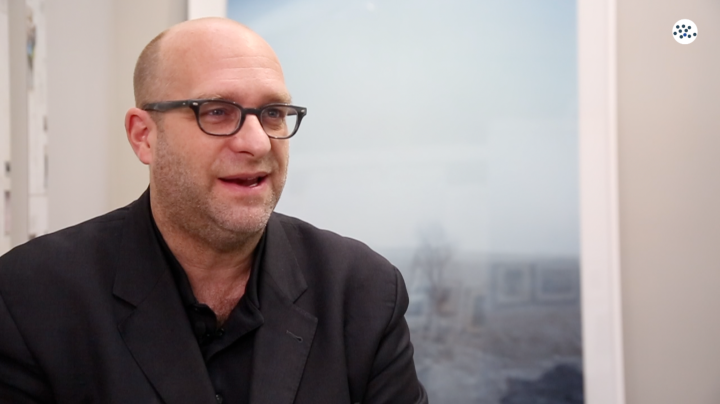
Todd Hido est un des photographes américains les plus respectés de sa génération. Après la publication d’un livre retraçant ses 25 ans de carrière, il revient sur son parcours et explique comment tout a commencé. Né dans l’Ohio, adolescent turbulent, il trouve un premier échappatoire dans la compétition de BMX dont il devient champion d’Etat plusieurs fois de suite. Il explique ce que ce sport lui apporte aujourd’hui dans son travail et enfin comment, faisant l’école buissonnière, il en est venu à la photographie.

“Je faisais des courses de BMX. Et comme n’importe qui faisant quelque chose d’éphémère comme une figure, on a besoin de le capturer sinon on n’a pas de preuve. Donc tous nos amis et moi nous avions des appareils photo. Et donc on se photographiait en plein saut ou en train de faire des figures.”

”Le BMX m’a été très bénéfique. Je suis devenu le champion d’Etat quatre fois de suite. Cette période a été extrêmement importante dans ma jeunesse. Soudain j’avais accompli quelque chose et je n’étais plus ce geek que personne ne choisissait dans l’équipe de baseball.”

“J’ai atteint un certain succès dans mon travail mais jamais je ne me relâche. Je ne lève le pied en aucune façon. Je creuse toujours pour aller plus loin. Et je travaille toujours aussi du que lorsque j’étais un étudiant de 20 ans.”

“Je me suis inscrit en classe de photo car c’était le dernier cours de la journée. Et tout le monde savait que si on entrait en cours suffisamment tôt en signant la feuille de présence, on pouvait aller en chambre noire avant que la lumière soit éteinte et s’échapper par la sortie de secours. Mais j’ai fini par aimer ce que je faisais et j’ai arrêter de sécher. C’est là que tout a commencé pour moi”


Todd Hido is one of the most respected American photographers of his generation. After the publication of his mid career book, he looks back to his youth and explains how it all began. Born in Ohio, a misbehaving teenager, he found a first escape in the BMX competition winning the State championship several times in a row. He explains how this sport taught him rules that he still applies today in his work and finally how, playing hooky, he came to photography.

“I used to race BMX. And like anybody that is doing something that’s temporal like a trick, you need to record it or it doesn’t exist. So all of my friends and I, we had cameras and we would photograph each other, jumping and doing our tricks.”

“The BMX was something really good for me. I became the State champion four times in a raw. So it was a huge part of my life growing up. I had all the sudden accomplish something instead of being this geek and this kid that nobody would pick on the baseball team.”

“I’ve reached a certain level of success with my work but I don’t relax at all and I’m not kicking back in any way. I’m sort of like plowing forward more I would say. And I work just as hard as when I was a 20 years old student.”

“I took the photography class because it was the last class of the day. It was commonly known that if you went in, got in there early and signed in, you could go into the dark room before they shut the lights off and open the backdoor, the fire exit, and leave. But eventually I liked what I was doing and started to stay. That’s where things began for me.”
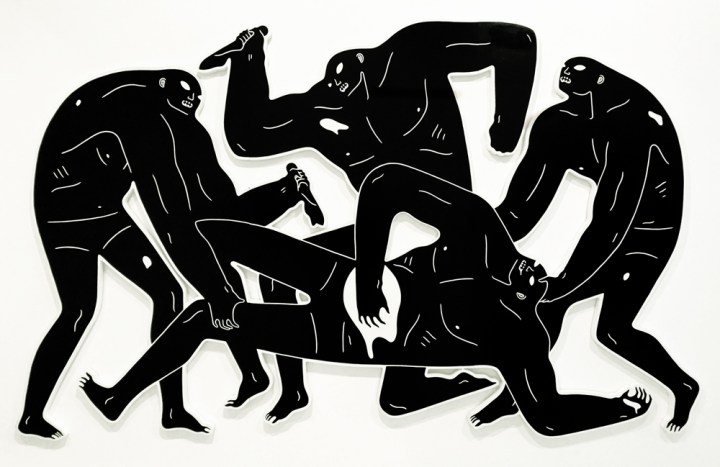
L’artiste américain Cleon Peterson présente sa première exposition solo à Paris. VICTORY se tient à la Galerie du Jour du 12 janvier au 18 février 2017.

Toujours fasciné par la violence, la brutalité et l’exercice du pouvoir entre les puissants et les marginaux ; l’artiste nous met face à une réalité qu’il a connu et qu’il observe encore. Son exposition résonne avec force au regard de l’actualité politique et sociétale aux Etats-Unis comme dans le monde.

«Cette exposition explore les triomphes hédonistes de ceux qui se reconnaissent comme victorieux dans le miroir du cours de l’histoire. Leur accession au plaisir dépend de leur projection de douleur sur le vaincu, ou l’expression courante du plaisir que l’on tire du malheur des autres. Alors que les vainqueurs font étalage de leur arrogance et remportent leurs trophées, les perdants sont considérés comme insignifiants et marginalisés. L’exposition VICTORY raconte la victoire d’un homme sur un autre, à quoi ressemble cette victoire, et les effets qu’elle exerce sur les perdants».


American artist Cleon Peterson presents his first solo exhibition in Paris. VICTORY is shown at the Galerie du Jour from January 12 to February 18, 2017.

Always fascinated by violence, brutality and the exercise of power between the powerful and the marginalized; the artist puts us in front of a reality he experienced and still observes. His exhibition resonates with force today in the light of the political and societal situation in the United States as in the world.

“This show explores the hedonistic triumphs of those who recognize themselves as victorious in the unfolding mirror of history. Their right to pleasure hinges on their projection of pain onto the unvictorious other. This often expresses itself in pleasure derived from the misfortune of the defeated. As the winners display their hubris and take their trophies the losers are left insignificant and marginalized. VICTORY explores one man’s victory over another, what that victory looks like and the result that victory has on the losers.”

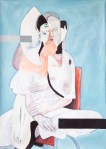
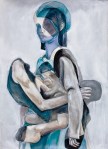
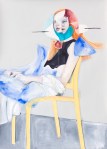
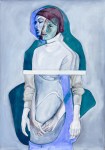
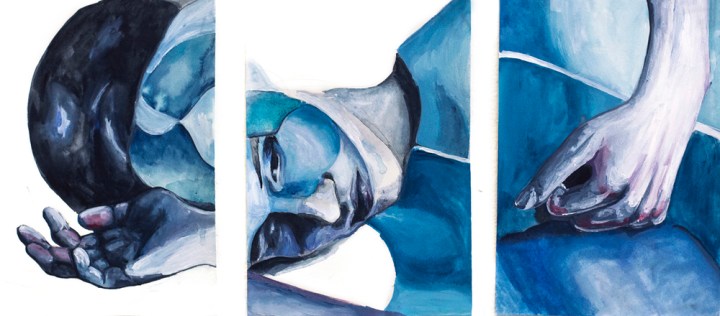
Isabelle de Kleine est une jeune artiste australienne qui pratique la vidéo et la peinture. Elle réalise des portraits en faisant des collages vidéo qu’elle réinterprète ensuite en peinture. En 2015 elle a accumulé de multiples récompenses dont le Macquarie Digital Portrait Award de la National Portrait Gallery de Canberra.
“La façon dont je considère la vidéo aujourd’hui est que c’est un moyen de créer une image animée, un portrait animé. Si vous pensez à une image fixe cela ajoute une dimension supplémentaire sans pour autant suivre les différentes conventions du film sur le fait d’avoir un début, un milieu et une fin. Ça n’a pas cette structure narrative qu’un film a en général.”

P.M.


Isabelle de Kleine is a young Australian artist who practices video and painting. She realizes portraits by making video collages that she reinterprets then in painting. In 2015 she won numerous awards including the Macquarie Digital Portrait Award from the Canberra National Portrait Gallery.
“The way that I’m seeing video at the moment is a way to create a moving image, a moving portrait. If you think about like a still it adds an extra dimension to that but it doesn’t need all those different conventions that a film puts in. Whether it’s having a beginning, middle and end. It doesn’t have this complete narrative structure that a film usually has.”

P.M.


Nathalie Boutté termine cette entretien en parlant du temps dont elle a eu besoin pour se considérer comme une artiste. Son entourage joue un grand rôle dans sa progression ; son galeriste et d’autres artistes. Elle explique les doutes et le temps nécessaire pour bâtir une carrière et une oeuvre. Enfin, elle parle de son ultime défi, le rêve de chaque artiste selon elle.

“Je ne me suis jamais dit : “Je veux devenir artiste.””

“Des moments de doute oui. Y en a systématiquement, presque à chaque fin de série. Quand la thématique s’arrête, quand il faut que je change de thématique, là c’est monstrueux. Je n’arrive plus à rien.”

“Puis on finit par retrouver une photo qui traine sur internet, un bout de texte, une chanson à la radio… et hop! A nouveau on retrouve une autre série, une autre thématique.”

“Une carrière d’artiste c’est long à démarrer. Beaucoup d’artistes ont un deuxième boulot. Il n’y a que 5% des artistes qui vivent de leur travail.”

“J’ai du mal à voir à long terme. Le CV se remplit vraiment au fur et à mesure. Je ne sais pas combien je gagnerai l’année prochaine, quels expos je vais faire. C’est vraiment petit à petit.”

“J’aimerais faire un très très grand format. Prendre le temps de trouver une belle histoire, de trouver le papier, le texte et de faire une pièce à tomber par terre. Mais je pense que c’est le défis d’un peu tous les artistes. Je ne sais pas si j’arriverais à la faire un jour celle là.”


Nathalie Boutté ends up this interview talking about the time she needed to consider herself as an artists. Her entourage has been very important for her to move forward ; her gallery owner and other artists. She explains the doubts and the time required to build up a career and a work. Finally she talks about her ultimate challenge, the dream of every artist according to her.

“I never told to myself : “I want to become an artist.””

“I have doubts yes. And I always have some each time I finish a set of work. When the theme is over, when I have to find another subject, that’s when everything collapses. I feel capable of nothing.”

“But finally I end up to find a picture on the web, a piece of text, a song on the radio… And there I have it! You start over again with another set of work, another subject…”

“Making a career out of your art is a long path. A lot of artists have a second job. Only 5% of them live from their art.”

“I can’t imagine things on the long run. The curriculum fills out as we go along. I don’t know how much money I’ll earn next year, what exhibition I’ll do. It goes bit by bit.”

“I would like to do a huge piece. Take the time to find a nice story, to find the right paper, the right text and make a piece to die for. But I guess that’s every artist’s challenge. I don’t know if I’ll ever manage to do it…”


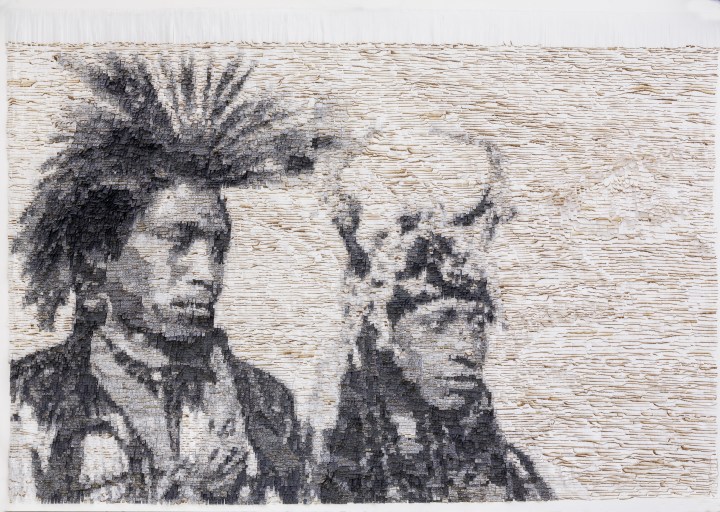
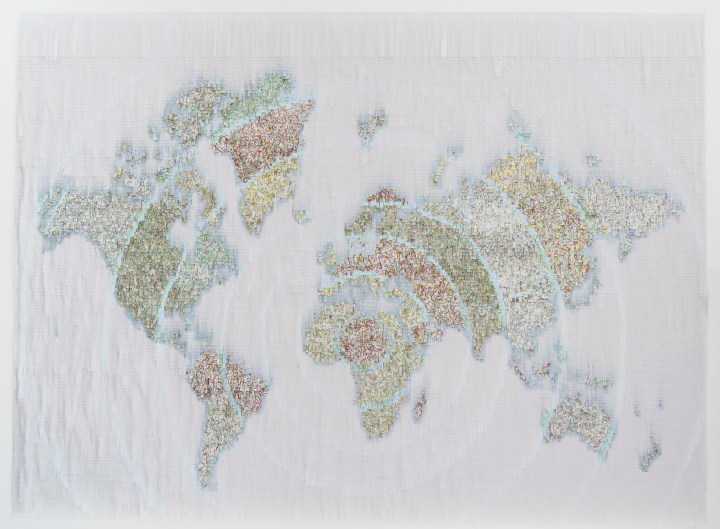
Dans cette deuxième partie Nathalie Boutté nous explique le pont entre son ancienne vie et l’actuelle. En tant que maquettiste elle a développé son goût et son talent pour les tâches techniques. Quand elle est devenue freelance, elle a découvert à quel point l’indépendance a libéré sa créativité. Dans cette nouvelle liberté elle s’est plongée dans son art, dont les premières pièces ont été inspirée par des artistes africains.

“Je suis rentrée dans le monde de l’édition effectivement par hasard. Mais ce que l’édition m’a amené c’est le côté technique. J’aime beaucoup la technique.”

“La technique m’a amenée dans mon travail de collage à être beaucoup plus précise et à savoir où je vais.”

“Je pense que c’est ça le déclic. C’est la rencontre de la liberté. Et la liberté, une fois que les portes sont ouvertes, ça part. Et donc du coup j’ai commencé à faire mon travail de collage.”

“Dans mon travail de collage, je cherchais l’assemblage du texte et du papier. J’ai assemblé ce que j’avais appris pendant 20 ans, de texte, de graissage de typographie, de recherche de quadri, de choses comme ça… J’ai essayé de le faire rentrer dans ce qui me donnait envie maintenant de continuer.”

“J’ai rencontré beaucoup d’artistes africains dont Malik Sidibé qui a vraiment inspiré mes premiers collages.”

“J’ai commencé par rencontrer les artistes peut-être avant de connaître un peu plus leur travail.”

“On se rend compte qu’en fait la contrainte des languettes et du collage, qui nous cadre quand même dans un milieu assez serré, en fait s’ouvre complètement. Et le champ de la création est assez impressionnant.”


In this second part Nathalie Boutté explains the bridge between her past life and the current one. Being a layout designer developed her love and her skills for technical tasks. When she turned freelance she discovered how independance released her creativity. In this new freedom she dived into her artwork, the first pieces of which were inspired by African artists.

“I worked in publishing by accident. But it brought me technical skills. I love technical things.”

“This technical knowledge allowed me to be more accurate in my collages and to know where to go.”

“That’s when I clicked. Finding freedom. And once you find freedom you dive into it. And that’s when I started to make collages.”

“In my collage work I wanted to blend text and paper. I tried to put together the knowledge I developed for 20 years about text, font size and research on four-color process printing… I just tried to repurpose it for something I was passionate about at that time.”

“I met a lot of African artists including Malik Sidibé who really inspired my first collages.”

“I began by meeting artists themselves before knowing their artwork.”

“We realise that the constraint of using paper strips for the collage, which sets boundaries, unlocks a lot of things. The scope of creation is impressive.”