Renowned British painter Glenn Brown has redefined the boundaries of contemporary art by merging Surrealism, Photorealism, and historical references into a unique visual language. Born in 1966 in a small mining village in northern England, Brown grew up surrounded by literature and music rather than visual arts. His work is celebrated for its meticulous detail, complex appropriations, and evocative distortions that invite viewers to question the meaning of art and originality.

The Early Foundations of Creativity

Brown’s formative years were marked by a love of books and music, fostered by his parents in rural Norfolk. He recalls his unexpected introduction to visual art through pop music:

“My first introduction to Henri Fantin-Latour’s paintings was by an album cover designed by Peter Saville for New Order.”

Programs from the Open University further expanded his education in art and film, giving him a rich cultural foundation before he ever set foot in an art college.

At art school, Brown’s education varied from academic life drawing to modernist theories of color and abstraction. He was influenced by the German and American art movements of the 1980s, including Gerhard Richter and Sigmar Polke, both of whom shaped his approach to the “death of painting.” As Brown explains:

“You build upon tradition, you play with it, and you break it whenever you want to.”

Painting in a Mediated World

Brown’s career has been deeply influenced by the concept of appropriation, drawing inspiration from artists like Sherrie Levine and Salvador Dalí. He reflects on the process of reinterpreting images:

“I loved Sherrie Levine’s photographs… where you become dizzy because you don’t know what to look at.”

This fascination led to his unique practice of creating “paintings of paintings,” using mediated images as his subject. His work bridges the gap between Photorealism and Surrealism, as seen in his pieces based on Dalí and science fiction illustrator Chris Foss. Brown notes:

“The idea of making photorealist paintings of photorealist paintings… seemed so mind-numbingly boring that I couldn’t bear to do it.”

Instead, he introduces distortions and layers that amplify fantasy and escapism.

A Dialogue Between Paintings – In the Altogether

For his exhibition In the Altogether, presented at Galerie Max Hetzler in Paris, Brown created a series of interconnected works over two years. He explains:

“Nothing was finished, but all the paintings were started, and they were all talking to each other.”

The paintings feature vibrant colors, dynamic contrasts, and intricate glazing techniques that add depth and complexity. For instance, Brown uses Indian yellow—a pigment derived from ox urine—to create unique tones:

“You apply this yellow over the top of a blue, and it turns this very peculiar green.”

One standout piece, The Untitled, is based on an Albrecht Dürer drawing. Brown manipulates the figure to blur gender distinctions, explaining:

“In my mind, it’s both Christ and Mary at the same time.”

The work includes a blank rectangle at the bottom, inviting viewers to title the piece themselves, an interactive gesture that encourages personal interpretation.

Humor, Depth, and the Role of Titles

Brown’s use of humor is central to his work, influenced by the deadpan wit of Marcel Duchamp. Titles like Dirty Little Seahorses and When the Satellite Sings are meant to provoke both laughter and deeper reflection. He describes the importance of titles:

“The title of a work is like adding an invisible color to the painting.”

Through this playful yet intellectual approach, Brown invites viewers to engage with his art on multiple levels, finding meaning and amusement in equal measure.

Glenn Brown’s Artistic Vision

With In the Altogether, Glenn Brown continues to push the boundaries of painting by combining meticulous technique with rich cultural references. His work reimagines the history of art while challenging viewers to question their perceptions. Whether through surreal landscapes or appropriated brushstrokes, Brown’s paintings create a dialogue between the past and present, offering a thought-provoking and playful exploration of humanity and creativity.
George Condo est un artiste américain né en 1957 et connu pour sa gamme de portraits largement inspirés par le cubisme, le surréalisme et les tableaux de maîtres anciens.

Habile dessinateur  depuis l’âge de 4 ans, il étudie la théorie de la musique et l’histoire de l’art. A travers ses lectures et ses études sur John Cage, Arnold Schoenberg … il identifie les liens entre la philosophie, la musique et la peinture. Le dialogue entre ces différentes langues définit l’art pour George Condo. Après quelques années d’études, il décide de quitter l’université pour devenir peintre.


George Condo is an American artist born in 1957 known for his range of portraits vastly inspired by cubism, surrealism and old masters paintings.

Skilled drawer since the age of 4 he studied music theory and art history. Through his readings and studies of John Cage, Arnold Schoenberg… he identified the connections between philosophy, music and painting. The dialogue between those different languages defines art for George Condo. After a couples of years studying, he decides to quit college to become a painter.

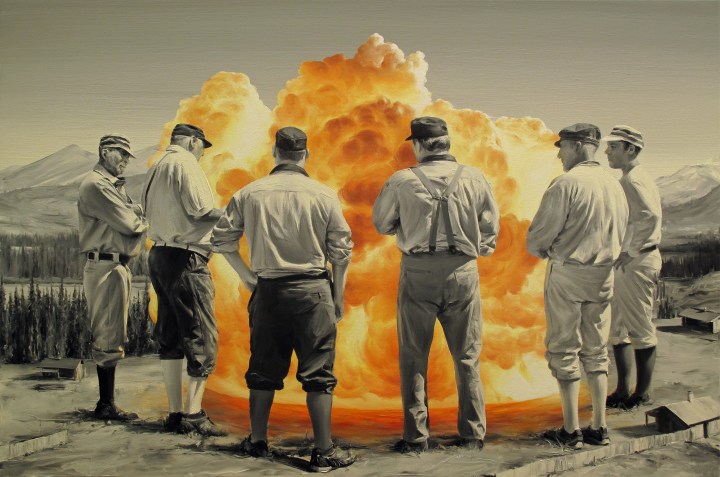
Entre néo-impressionnisme et surréalisme pop, les peintures de l’Espagnol Paco Pomet se basent sur de vieilles photographies. L’artiste explore des époques de flâneries absolues, de conquêtes technologiques, d’explorations de terres perdues ou de révolutions industrielles. Souvent dans ses toiles, l’homme devient la proie de ses expérimentations, le sujet principal de la photo d’origine devient secondaire, le scientifique est façonné par sa création et la Nature prend la place de l’homme sous les traits d’animaux en costumes ou même de palmiers conduisant une décapotable. “Je tente de déstabiliser et de modifier l’ordre des éléments qui configurent la structure de la scène dans chaque peinture, afin que l’image résultante propose un nouvel ordre visuel.” Des situations déroutantes, à contre-pied qui ont particulièrement séduit Banksy qui a sélectionné des oeuvres de l’artiste pour son parc Dismaland.

P.M.


Between neo-impressionism and pop surrealism, the paintings of the Spanish Paco Pomet are based on old photographs. The artist explores times of absolute idleness, technological conquest, exploration of lost land or industrial revolutions. Often in his paintings, man becomes the prey of his experiments, the main subject of the original photo becomes secondary, scientific is shaped by its creation and Nature takes the place of humans in as animal in costumes or even as palm trees driving a convertible. “I try to destabilize and alter the order of the elements that configure the structure of the scene in each painting, so the resulting image proposes a new visual order.” The confusing or off balanced situations have been particularly noticed by Banksy who selected the artist’s works for his Dismaland park.

P.M.

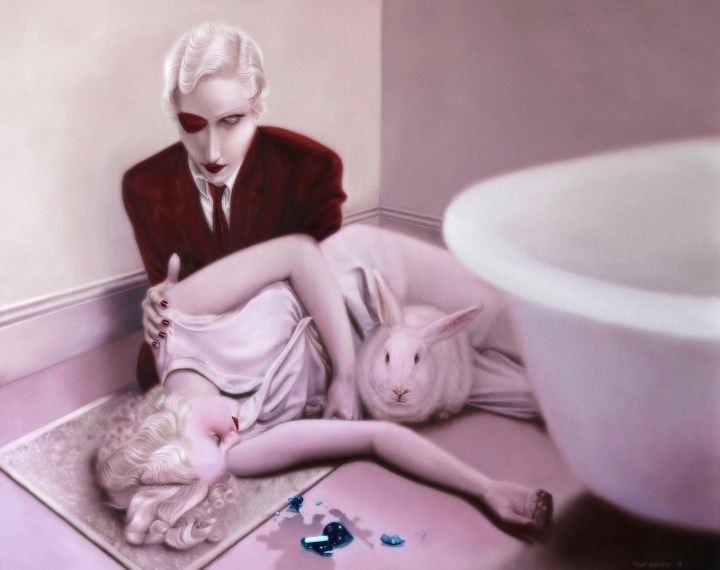
Les femmes fatales peintes par le Canadien Troy Brooks sortent tout droit d’un film noir au scénario énigmatique. Anamorphosées avec des visages très allongés, elles inquiètent par cette quasi-monstruosité et leur regard dérangé à la manière des modèles de John Currin ou de l’expressionniste allemand Otto Dix. Troy Brooks revendique le côté kitsch et frontal de son travail et son appartenance au Surréalisme Pop :

« Si vous aimez les allégories, le Surréalisme Pop est un peu comme le jeune bâtard flashy, illégitime et lourdement tatoué conçu pendant une grande et folle orgie de mouvements artistiques, qui débarquerait bourré à une garden party de country club. On ne parle pas ici d’un bateau pastel, flottant près d’un quai beige, ni d’un crucifix en plastique immergé dans un verre de pipi. Ceci est une nouvelle souche d’un art à la technique précise, à la fois moderne et classique, dans le sens où elle est créée par une nouvelle espèce d’artistes inspirés par un très large champ d’influences sur plusieurs siècles. Ils ont développé une sorte d’hyper-sophistication visuelle après avoir été exposés toutes leurs vies à une infinité de styles par les médias et la pop culture. »

P.M.


The « Femmes Fatales » painted by the Canadian Troy Brooks come straight out of a film noir with an enigmatic scenario. Slightly distorted with their very long faces, they almost worried by their slight monstrosity and their disturbed look like the models of John Currin or German expressionist Otto Dix. Unapologetic, Troy Brooks asserts the kitsch and the boldness of his work and his membership of the Pop Surrealism :

« If you like allegories, Pop Surrealism is sort of like the young, flashy, heavily tattooed illegitimate bastard from a big crazy art movement orgy that crashes the country club garden party, drunk. It’s not a pastel boat floating by a beige dock, and it’s not a plastic crucifix submerged in a glass of pee. This is a new strain of technique-heavy art that is simultaneously modern and classic, in the sense that it’s made by a new breed of artists taking from a very broad scope of centuries worth of influences.This new breed has developed a kind of hyper-visual sophistication from being exposed to endless styles of media and pop culture their entire lives. »

P.M.