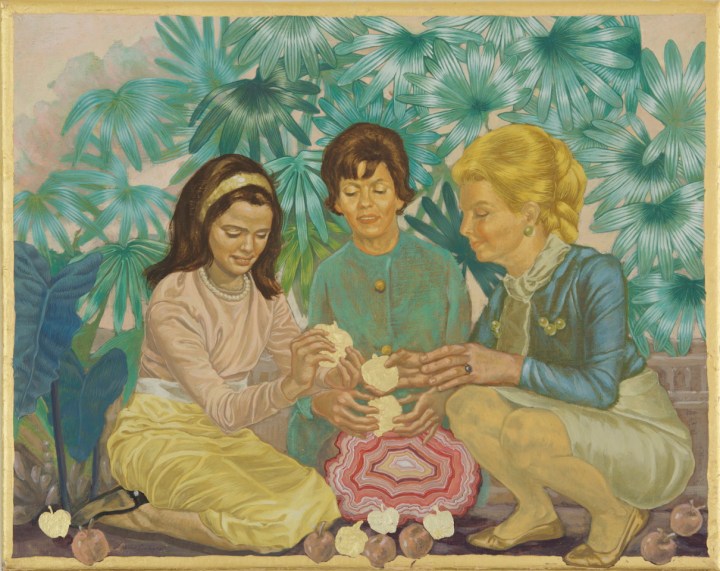
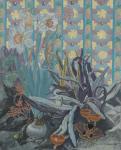
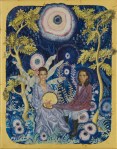
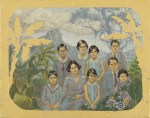
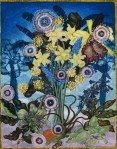
Ce ne sont pas les couches d’or 22 carats appliquées sur ses toiles qui rendent la peinture de l’américaine Larissa Bates riche, mais la concentration d’influences et de références qu’elles recèlent. Elles traversent les âges : des miniatures persanes à la peinture surréaliste de Frida Kahlo, dont une de ses toiles s’inspire, – “Two Ubumes as Twin Gestational Carriers After The Two Fridas” – en passant par les enluminures du Moyen-Âge ou les natures mortes de Bosschaert. Les sujets de l’artiste d’origine costaricaine restent néanmoins contemporains. Son arrière-grand-père puis son grand-père dirigeaient l’entreprise United Fruit, une entreprise américaine implantée au Costa Rica à la fin du XIXème siècle, apportant richesse économique mais aussi discorde et discrimination entre employés et population locale. Ainsi on trouve dans les toiles de Bates des détails de cette confrontation culturelle : une jonquille de Nouvelle-Angleterre au milieu de plantes tropicales ou des familles multiculturelles et mutuellement influencées l’une par l’autre. Une artiste marquée par son métissage : “Les feuilles de bananes me font pensées aux imprimés des tissus dans les maisons de location pour touristes en Amérique Centrale. Un croisement textile entre la culture WASP et la tradition sud-américaine. J’imagine un groupe d’Américains très chics de la côte Est portant des imprimés banane et buvant du gin-tonic en regardant le soleil se coucher ; un paradigme dans lequel je m’inclus, étant aujourd’hui plus touriste que Costaricaine sur les terres de mon enfance, le pays où ma mère est née.

P.M.


The 22 carats gold layers applied on their canvas are not what makes the paintings of the American Larissa Bates rich, but the concentration of influences and references they contain. They cross the ages: from Persian miniatures to the surrealist painting of Frida Kahlo, of which one of her paintings is inspired – “Two Ubumes as Twin Gestational Carriers After The Two Fridas” – through the illuminations of the Middle Ages or Bosschaert still lifes. The subjects of the Costa Rican originated artist remain nevertheless contemporary. Her great-grandfather then her grandfather ran United Fruit, a US company established in Costa Rica at the end of the nineteenth century, bringing economic wealth but also discord and discrimination between employees and local residents. Thus we find in Bates’ paintings details of this cultural confrontation: a daffodil form New England in the middle of tropical plants or multicultural families influenced one by the other. An artist marked by her interbreeding: “The banana leaves make me think of tropical textiles in tourist rentals in Central America. The WASP/Latina textile crossover. I imagine a bunch of WASP’s wearing banana shirts and dresses while drinking gin and tonics overlooking a sunset, a paradigm that I strangely fit into, now more gringa tourist than tica, in the land of my childhood and my mother’s birth country.

P.M.

Images : Monya Rowe Gallery

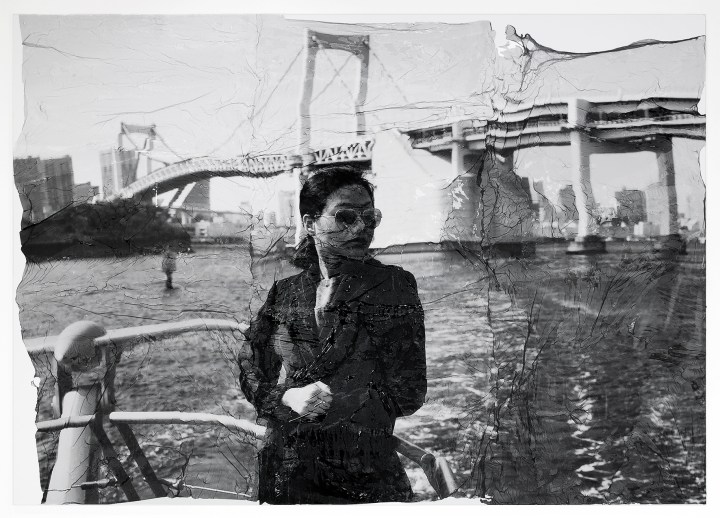
On a deux vies, et la deuxième commence quand on se rend compte qu’on en a qu’une.” L’artiste française Sylvie Bonnot applique presque ce précepte de Confucius aux photographies de sa série “Mues”, des images qu’elle dépèce pour en poser l’épiderme sur toile. Cette métamorphose donne une nouvelle dimension aux images. On a d’abord l’impression d’une illusion puis, d’une confusion et on comprend enfin qu’il s’agit d’un passage à la maturité. C’est un souvenir qu’on assume, une acceptation de soi comme un papier froissé qu’on finit par récupérer.

P.M.


We have two lives, and the second begins when we realize that only have one.” The French artist Sylvie Bonnot almost apply this Confucius precept to the photographs of her series “Mues” (slough), images that she cuts up to put their epidermis on canvas. This metamorphosis brings a new dimension to the images. First we have the feeling of an illusion then of confusion and we finally understand that it is a coming of age. It is a memory that is assumed, a self-acceptance like a crumpled paper that we eventually recover.

P.M.

Images : Galerie Ségolène Brossette

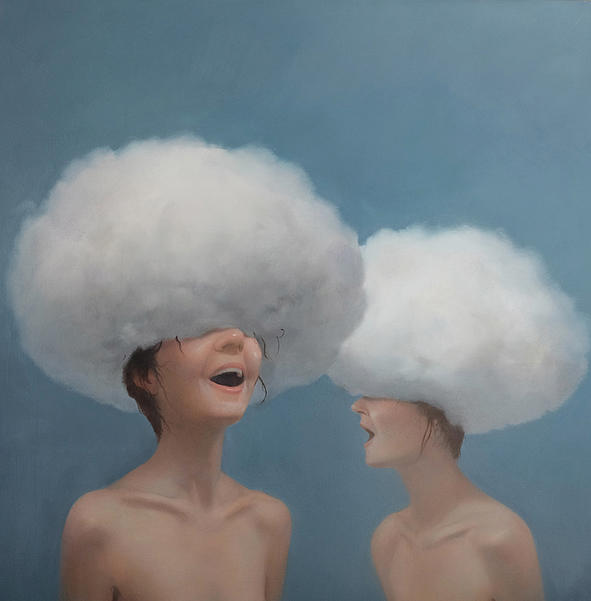
Les sujets du canadien Yang Cao semblent se cacher, s’isoler, mais ils se laissent trahir par leur gestes ou les nuages à travers lesquels leurs émotions transparaissent. En effet, pour l’artiste, les nuages comme les être humains ont un comportement erratique, “ils changent de forme et de lieu au gré du vent.”  Une observation sur une société dont il regrette pourtant le manque de recul ou de perspective : “Si j’en avais le pouvoir, j’enverrai les dirigeants de chaque pays voyager dans l’espace afin qu’ils constatent à quel point notre monde est petit.

P.M.


Characters by the Canadian painter Yang Cao seem to hide, isolate themselves, but they let themselves betrayed by their gestures or the clouds through which their emotions are reflected. Indeed, for the artist, clouds as human beings have erratic behavior, “they change shape and place in the wind.” An observation about a society  of which he nevertheless regrets the lack of distance or perspective: “If I had the power, I would send every leaders of every countries on a trip to space to look how small is everything.

P.M.

Dans cette seconde partie, Erwin Olaf raconte sa découverte de la photographie, sa passion grandissante pour ce medium et l’évolution de son art.


In this second part, Erwin Olaf tells us about his discovery of photography, his growing passion for this medium and the evolution of his art.

Guillermo del Toro le décrit comme un “maître du Rococo post-industriel”. Les incroyables sculptures de l’artiste américain Kris Kuksi, conçues en partie d’objets de récupération et de figurines de maquette, racontent autant d’histoires qu’il y a d’angles et de détails à observer. Elles nous plongent d’abord dans un univers morbide et rendraient fier tout pirate qui en ornerait la poupe de son navire. Il s’inspire autant de l’art gothique que de l’iconographie heavy metal – ayant passé sa jeunesse passée à reproduire les pochettes d’albums d’Iron Maiden qui, à l’époque, représentaient pour lui la plus haute forme d’art. Kuski qualifie son travail d’équilibre entre chaos et symétrie et on y trouve un caractère religieux (“Saint Michel Tuant le Serpent”) ; pour lui “l’homme est limité par son avidité et sa négligence. Alors qu’il en a conscience, il ne fait pas toujours le bon choix pour améliorer son sort.” Il déclare que “si l’homme pouvait faire face à ses pulsions sombres, il pourrait les surmonter.” Une quête de rédemption qu’il illustre dans ses sculptures qu’il fabrique dans son studio du Kansas… situé dans une vieille église du 19ème siècle.

P.M.


Guillermo del Toro describes him as a “post-industrial Rococo master”. The pieces of the American artist Kris Kuski, partly made of salvage and model kit parts, tell as many stories as there are angles and details to observe. They plunge us in a morbid universe and would make proud any pirate having it on the stern of his ship. He uses references from gothic art  iconography but also from heavy metal culture resulting from his youth spent reproducing the Iron Maiden album covers which, at the time, for him the highest form of art. Kuski describes his work balance between chaos and symmetry and there is also a religious reading to his work (Saint Michael Killing the Serpent); for him, “the man is limited by his greed and negligence. Even if he knows it, he is not always making the right choices to improve his fate.” He said that “if man could embrace his dark impulses, he could overcome them.” A quest for redemption illustrated in his sculptures built in his studio based in Kansas… in an old 19th century church.

P.M.