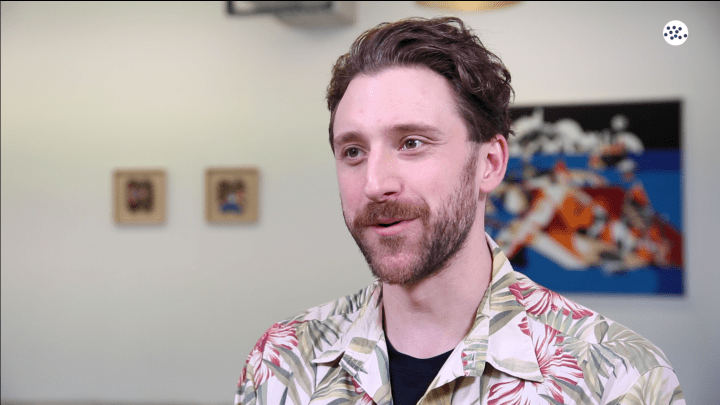
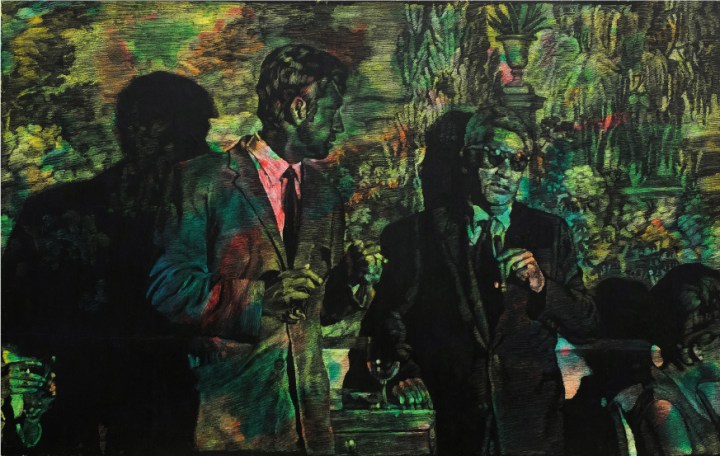
Dans cette dernière partie, Katharina Ziemke parle de sa rencontre avec Thomas Ostermeier qui a joué un rôle important dans l’évolution de son travail. Elle insiste sur l’importance de produire une oeuvre personnelle et singulière et rappelle que les artistes doivent prendre leur temps tout en puisant leur inspiration dans différents domaines.

“Je n’ai jamais été à l’aise avec le travail de commande.”

“Il ne faut pas être trop pressé et s’écouter soi-même.”

“J’aime beaucoup les artistes qui ont quelque chose de très personnel, que l’on ne voit pas ailleurs et qui arrivent à le formuler.”

“J’ai des phases où je sens que je suis en train de changer, c’est souvent après quelques années, après 3 ou 4 ans. Là je fais des choses que je montre un peu moins, qui sont plus des essais.”

“La lumière sera toujours ma motivation.”


In this last part, Katharina Ziemke talks about her meeting with Thomas Ostermeier, who played an important role in the evolution of her work. She stressed the importance of producing a personal and singular work and said that artists should take their time while drawing inspiration from different areas.

“I’ve never been comfortable with commissions.”

“You musn’t be in a hurry and you have to listen to yourself.”

“I love artists who carry something very personal, that we don’t see elsewhere and who manage to express it in their work.”

“At some stages I feel I’m changing. It often occurs after a few years, like 3 or 4. That’s when I make things that I don’t really show, that are more experimentations.”

“Light will always be my main motivation.”
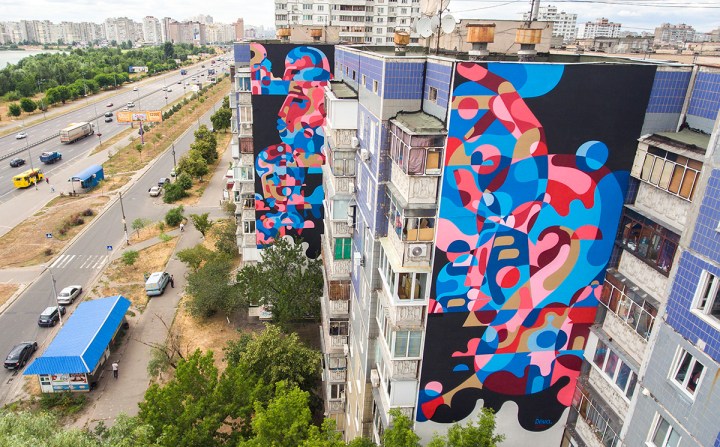
Reka One dans cette dernière partie nous explique qu’il est important de se tromper et d’expérimenter dans son art car, à son sens, c’est le seul moyen de progresser et de s’épanouir. C’est aussi un message qu’il adresse aux jeunes artistes parmi d’autres conseils. James Reka exprime enfin son désir d’aller vers d’autres supports toujours dans cette volonté de développement et d’évolution de son art.

“Je n’ai jamais pensé que si je pouvais remonter le temps, je ferais les choses différemment. Car toutes les erreurs que j’ai pu faire m’ont amené là où je suis aujourd’hui. J’aime faire des erreurs car c’est comme ça qu’on apprend la vie.”

“Si vous travaillez sur une oeuvre avec trop de confiance, comme si vous aviez une recette, sur le plan de l’évolution, vous ne progresserez pas en tant qu’artiste. Ça n’arrivera pas si vous ne prenez pas de risque et ne faites pas d’erreur.”

“Ce que je peux conseiller aux jeunes artistes et street artistes est de rester réalistes. Il faut se rendre comptes que ça prend des années d’atteindre ses objectifs. Il faut vraiment être déterminé, s’y coller et être persévérant. Vous y arriverez si c’est vraiment votre passion.”

“Quand je travaille en studio pour faire des oeuvres, j’explore des voies différentes que je ne pourrais pas pratiquer avec du street art. Dans une galerie je peux faire des expérimentations sur différents supports ou textures. Peut-être que je m’autorise plus à me trompe dans ce travail.”


In this last part, Reka One explains the importance of being wrong and of experimenting in his art because, in his view, it is the only way to expand and evolve. It is also a message he gives to the young generation of artists among other advices. James Reka finally expresses his desire to go to other media in his constant desire for development and evolution in his art.

“I never view that if I could turn back the clock I would approach things differently. Because through a lot of mistakes that I have made, it has directed me where I am now. I do enjoy making mistakes because this is how you learn in life”

“If you’re working on something that you are confident with, and you know that there some kind of formula, where talking about evolution here, and I don’t see artists evolving if they are not taking risks and making mistakes.”

“My advice to the next generation of artists and street artists is that they do have to be realistic and realise that it takes many many years to be able to reach your goals. To be determined and to stick in there, be persistent and you will reach your goals if you are truly passionate about it.”

“Working in a studio and making artwork, I got to explore different avenue that I would never be able to take my street work in. In a gallery I’m able to experiment a lot more with different mediums, textures.Maybe I’m allowing more room for error with my artwork”

“I do want to expand and I’m feeling the hitch to try out other things. I love photography and I also love to use my hands.”

James Reka explique l’origine de son style qu’il a développé pendant plus de 15 ans notamment grâce à ses influences classiques. Connu pour son Street art mais venant du graffiti, il nous donne son avis sur ces deux mouvements entre lesquels il peut y avoir des frictions.

“Mon outil de prédilection est la bombe aérosol. J’ai développé mon style avec la manière dont j’aime utiliser la peinture en spray.”

“Ce n’est pas arrivé en une nuit. J’ai commencé comme tout débutant en m’inspirant du travail d’autres artistes. Puis ensuite on le fait à sa manière.”

“Néanmoins mon inspiration ne vient pas toujours du travail des autres. Elle provient aussi de mon quotidien. Je peux marcher dans la rue et voir une belle texture sur un mur et m’en inspirer. J’ai toujours un appareil photo sur moi et je prends beaucoup de clichés”

“Ce qui m’attirait c’était la rue, son côté brut et l’énergie qui s’en dégageait.”

“Le street artistes doivent s’exprimer selon les règles du graffiti. Il y a beaucoup des règles non dites aussi. C’est étrangement très structuré même si c’est une forme d’expression très libre.”

“J’ai beaucoup de chance de pouvoir dire que je suis un artiste et de pouvoir vivre de mon art.”


James Reka explains the origins of his style that he developed for over 15 years particularly thanks to its classical influences. Known for his Street art but coming from the graffiti world, he gives us his opinion on these two movements between which there can be friction.

“My favourite tool is the spray can. I’ve developed my style around the way I like to use spray paint.”

“It didn’t happen overnight, I started somewhere. Often when you begin, you take a lot of inspiration from other artists and you make you’re making it to your own.”

“However some of the inspiration I get is not looking at other people’s artwork. It’s my day to day life. I walk down the street and see a beautiful texture on a wall and I get inspiration from that. I always take my camera everywhere and I take photos of everything.”

“What attracted me was the streets, the rawness and the energy.”

“Street artists need to play by graffiti rules. There are a lot of unspoken rules as well. And there’s a lot of structure even though there is such a free expression.”

“I’m very lucky to be able to say that I’m an artist and I can survive of my artwork.”

James Reka ou RekaOne, est un street artiste australien. Issu d’une famille de créatifs, il est très vite attiré par le graffiti qu’il découvre en prenant le train chaque jour pour se rendre à l’école. Il explique la naissance de sa passion, notamment animée par son goût du risque, et son évolution vers la quête d’un style unique.

“J’ai grandi près d’une voie ferrée. Je prenais le train tous les jours pour aller à l’école et sur les voies je voyais passer toutes ces couleurs en mouvement.”

“J’aimais l’idée que ces types sortaient la nuit pour faire des oeuvres illégalement. Ils risquaient tout pour leur passion, pour être créatifs.”

“Même si j’avais un très bon professeur d’art, les autres enseignants me faisaient comprendre qu’il était difficile de vivre de son art.”

“Quand j’ai débuté le street art, je n’avais pas l’intention d’exposer dans des galeries. Je faisais tout gratuitement, dans la rue, par passion, par goût du risque. Je fuyais la police…”

“Le monde du graffiti m’a appris qu’il était important de développer son propre style. Que c’était plus important que le contenu.”


James Reka a.k.a. RekaOne, is an Australian street artist. Coming from a creative family, he’s quickly attracted by graffiti that he discovered by taking the train each day to get to school. He explains the birth of his passion, especially driven by his taste for risk, and its evolution to the quest for a unique style.

“I grew up near a train line. It was my first exposure to graffiti. I would catch the train everyday to go to school and on the train lines I would see all those colours and movement.”

“I liked the idea that these guys were going out at night doing illegal work basically. They were risking everything for their passion, to be creative.”

“Even though I had a very good art teacher, the other teachers tried to make me realise that it wasn’t that it is very difficult to make money out of your art.”

“Originally when I started, I had no intentions of being a gallery artist. I was doing everything for free, on the streets, for the passion, for the risk. Running from the police…”

“One of the elements that I’ve learnt from the graffiti world is that it is important to pursue style as the most important think over content.”

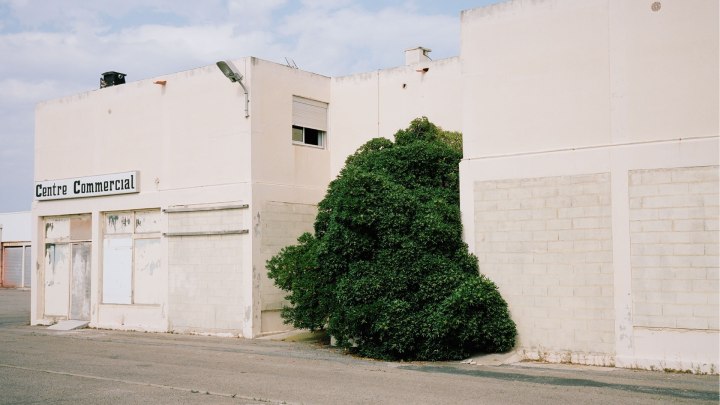
A travers sa propre expérience, Shane Lynam nous donne son point de vue sur la façon d’appréhender la photographie d’art quand on débute et que l’on souhaite en vivre. Lui qui a quitté son job pour se consacrer à la photo, il nous explique la façon dont il a géré sa carrière, sa méthode de travail et comment il envisage son avenir.

“Pour la plupart quand on trouve ce qu’on veut faire, c’est un formidable moment dans sa vie. Mais pour moi c’est une pression à accomplir et de savoir comment je vais y arriver. C’est une chose qui peut-être stressante.”

“Quand on débute dans la photographie, ça prend un moment avant de gagner de l’argent.”

“Pour moi le plus important est de progresser tout le temps. Ce n’est pas forcément faire la meilleure photo mais lui donner plus de sens et de force.”

“Je pense que je ferai toujours de la photo. Quoiqu’il advienne je me vois enchaîner les projets. Que les gens les voient ou pas.”

P.M.


Through his own experience, Shane Lynam gives us his views on how to comprehend art photography when you begin and make a living from it. He who left his job to devote himself to photography,explains how he managed his career, his working method and how he sees his future.

“I guess people talk about once you figure out what you want to do, it’s a great moment in your life. But there’s almost a pressure then to realise it and how you’re going to go about making it all happen. It can almost be a kind of a stress.”

“Photography, especially when you’re starting out, takes a while before you start making money.”

“With me the most important is just improving all the time. Not necessarily making the best photo ever just make the work more meaningful and stronger.”

“I think I’ll always make work for the rest of my life. No matter what happens, I see myself making projects after projects whether anyone sees it.”

P.M.