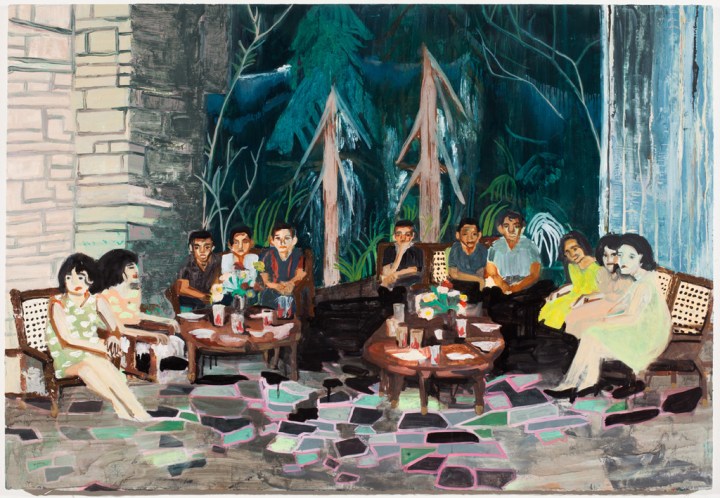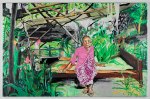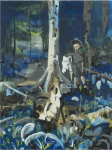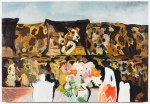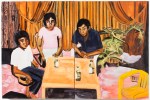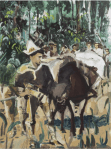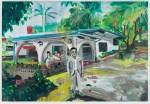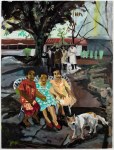
Maia Cruz Palileo est une artiste américaine née à Chicago et issue d’une famille d’immigrés philippins. Fascinée par ses origines elle se nourrit d’histoires racontées par ses parents et grands-parents sur leur archipel et leur mode de vie. Artiste pluri-média, elle a un jour souhaité créé une installation reconstituant le salon de ses grands-parents en se basant notamment sur des photos et des vidéos des années 80. Elle a fait le constat que tout était finalement très américanisé ce qui a développé son intérêt pour la mémoire des migrants, leur motivation et leur désir ou non d’oublier leur vie passée. Elle est retournée aux sources pour visiter ses oncles et tantes restés au pays, se baigner dans l’atmosphère locale et s’imprégner de souvenirs.

Sa dernière série de peinture est un mélange de toutes ces expériences ; les souvenirs de son enfance, les histoires et photos ramenées du pays et ses propres souvenirs. Certaines de ses toiles reproduisent de vieilles photos de familles abîmées par le temps. Elle comble les zones sombres avec les images de végétation qu’elle a retenu de son voyage. Elle substitue les couleurs de son imagination aux flous des clichés.

“Mes notions de la maison ont changé au fil des années. Dans ce sens, elles sont respirables, poreuses et légères, plutôt que denses et impénétrables. Je pense que la mémoire et l’imagination sont le liant qui permet de fusionner des récits existants, ceux-là même, sont perméables, changent toujours et sont remplis de trous. Je suis aussi très attirée par l’hybridation et par le mélange entre des univers et des époques. Nombre des personnages dans mes peintures ont un pied dans deux monde différents.”

P.M.


Maia Cruz Palileo is an American artist born in Chicago and from a family of Filipino immigrants. Fascinated by her origins she feeds on stories told by her parents and grandparents about their archipelago and their lifestyle. Cross-media artist,  one day she wanted created an installation recreating the living room of her grandparents notably based on photos and videos of the 80’s. She noted that everything was actually very Americanized which developed her interest for migrants memories, their motivation and their desire or not to forget their past life. She traveled to her roots to visit her aunts and uncles back home, roaming in the local atmosphere and soak up memories.

Her latest series of paintings is a mixture of all these experiences; the memories of her childhood, stories and pictures and the memories brought back from her travel. Some of her paintings reproduce old photographs of families damaged by time. She fills the dark areas with images of vegetation that she recalled from her trip. She substitutes the snapshot blurs with colors from her imagination.

“My notions of home have changed over the years. In that way, they are breathable, porous and light, rather than dense and impenetrable. I think memory and imagination are the glue for merging existing narratives, and they, too, are permeable, always changing and filled with holes. I am also definitely drawn to hybridity and to mixing worlds and time periods. Many of the characters in my paintings tend to have one foot in two separate worlds.”

P.M.

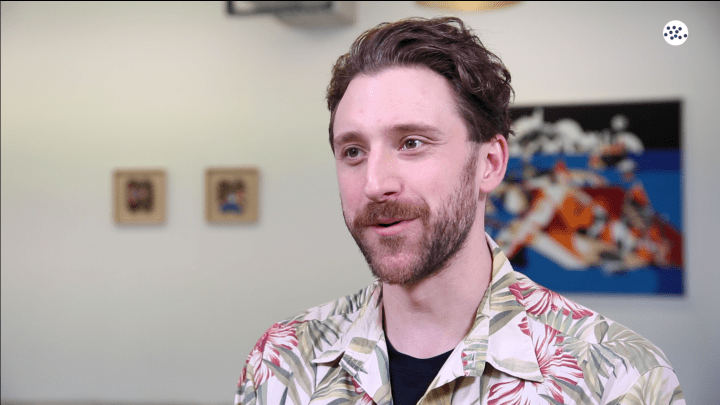
A travers sa propre expérience, Shane Lynam nous donne son point de vue sur la façon d’appréhender la photographie d’art quand on débute et que l’on souhaite en vivre. Lui qui a quitté son job pour se consacrer à la photo, il nous explique la façon dont il a géré sa carrière, sa méthode de travail et comment il envisage son avenir.

“Pour la plupart quand on trouve ce qu’on veut faire, c’est un formidable moment dans sa vie. Mais pour moi c’est une pression à accomplir et de savoir comment je vais y arriver. C’est une chose qui peut-être stressante.”

“Quand on débute dans la photographie, ça prend un moment avant de gagner de l’argent.”

“Pour moi le plus important est de progresser tout le temps. Ce n’est pas forcément faire la meilleure photo mais lui donner plus de sens et de force.”

“Je pense que je ferai toujours de la photo. Quoiqu’il advienne je me vois enchaîner les projets. Que les gens les voient ou pas.”

P.M.


Through his own experience, Shane Lynam gives us his views on how to comprehend art photography when you begin and make a living from it. He who left his job to devote himself to photography,explains how he managed his career, his working method and how he sees his future.

“I guess people talk about once you figure out what you want to do, it’s a great moment in your life. But there’s almost a pressure then to realise it and how you’re going to go about making it all happen. It can almost be a kind of a stress.”

“Photography, especially when you’re starting out, takes a while before you start making money.”

“With me the most important is just improving all the time. Not necessarily making the best photo ever just make the work more meaningful and stronger.”

“I think I’ll always make work for the rest of my life. No matter what happens, I see myself making projects after projects whether anyone sees it.”

P.M.

Philippe Baudelocque est un artiste français né en 1974 dans une famille de musiciens ouverte à la culture avec un père artiste animalier. Jeune adolecsent au moment où le hip-hop et le graffiti explosent en France, il fait ses premiers pas artistiques en taguant son pseudo, Fusion, lors de ses explorations urbaines. C’est en allant à New York où il rencontres les pionniers du street art qu’il réalise que cette culture n’est pas en phase avec sa philosophie. Il conserve la passion des dessins sur grande surface, des lettrages et de l’énergie de cette discipline pour se l’approprier et l’interpréter à sa façon.

C’est en 2009 qu’il tombe face à un mur noir, rue du pont aux choux, et qu’il décide de faire son premier dessin à la craie. L’animal cosmique qu’il réalise est alors photographié et fait le tour de la blogosphère, il a trouvé son style. Si les animaux sont très représentatif de son travail, c’est à la nature au sens large qu’il s’intéresse. La nature est pour lui notre univers, le cosmos et toutes les interactions qui en résultent.

“Quand le graffiti est arrivé, ce qui m’a beaucoup intéressé c’est l’énergie. C’était tellement différent de tout ce que je voyais.”

“Je participe à cette forme d’art mais à ma manière. C’est à dire que ce n’est pas spécialement le coté vandalisme de la chose qui m’intéressait. Je retenais juste l’expérimentation des lettres et des formes dans des endroits désaffectés.”

A propos de ses premiers dessins à la craie :
“Je n’étais pas du tout dans le sens à penser à tout. Pas du tout. C’est vraiment le prix. Avec un paquet de 10 ou 12 craie on peut faire un grand mur comme ça. J’étais pragmatique, c’était vraiment ça.”

“C’est là que j’ai pris conscience que je me sentais bien en faisant ça. Je ne marche sur aucun pied. Je suis chez moi. Je suis chez moi, tranquille, je parle de choses qui m’intéressent profondément et qui me touchent.”

“Je doute encore, de tout. Mais fondamentalement j’ai l’information. Quand je me connecte vraiment avec mon coeur, avec moi tout entier. C’est cet état où tout est calme, tout est limpide, où il n’y a strictement aucune pensée.”

P.M.


Philippe Baudelocque is a French artist born in 1974 into a family of musicians open to culture with a naturalist father. Young adolecsent when hip-hop and graffiti shot up in France, he made his first artistic steps by tagging his nickname, Fusion, during his urban explorations. When he went to New York, he encountered the pioneers of street art and realized that this culture was not in line with his philosophy. He retained the passion of drawing on large area, lettering and of the energy of this discipline and interpreted it in his own way.

It was in 2009 that he came across a black wall, rue du Pont aux Choux, and decided to make his first drawing with chalk. The cosmic animal he realized is then photographed and went around the blogosphere, he then found his style. If animals are very representative of his work, he is interested in nature in its wide sense. Nature is for him our universe, the cosmos and all the interactions that result from it.

“When I discovered graffiti what I really enjoyed was the energy. It was so different than what I was used to.”

“I get involved in the graffiti movement. But in my own way. Because I was not interested in the vandalism aspect of it. I was more into experimenting letters and shapes, in closed down places.”

About his first drawings with chalk:
“At that time I wasn’t thinking up everything. Not at all. It was really a matter of price.With a pack of 10 or 12 chalks, I could draw on such a big wall. The idea was as simple as that, pragmatic.”

“This is when I’ve been aware of how good I was feeling doing this. I wasn’t stepping on anyone foot. I feel at home. I’m in my house, quiet. I’m on something deeply interesting that moves me.”

“I still have doubts, on everything… But fundamentally, deep inside me I have the information. When I’m connected with my heart, my inner self. It is a state when everything is quiet and crystal clear. When you don’t think of anything.”

P.M.

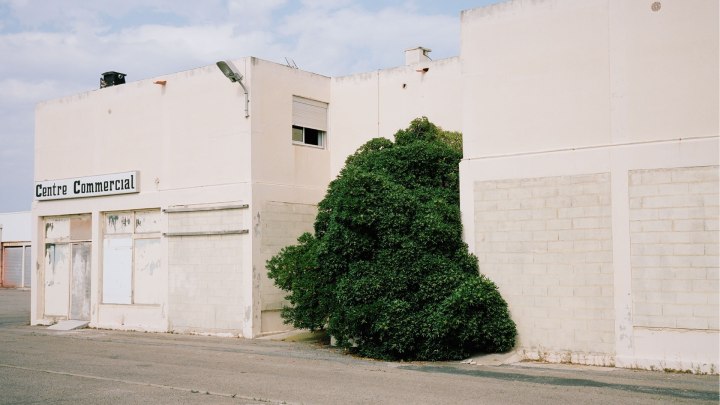
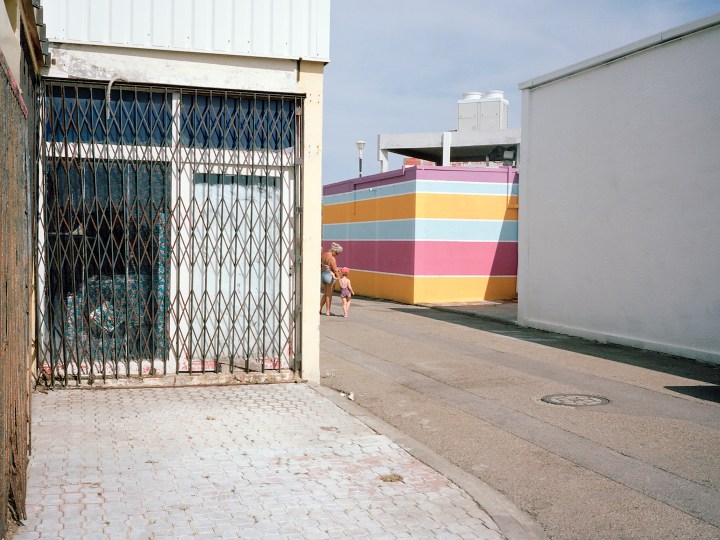
Dans cette deuxième partie Shane Lynam nous explique la façon dont il a construit son style. Ayant fait des études dans ce domaine, il s’intéresse à l’impact de la conjoncture économique et des décisions politiques sur l’urbanisme à travers le temps. Son regard se pose sur l’évolution des interactions des populations avec ces lieux parfois anachroniques mais qui tentent de s’adapter à la société d’aujourd’hui. Il nous livre également son avis de photographe sur l’âge d’or que l’Irlande a connu avant de s’effondrer à la crise de 2008.

“La photo devenait quelque chose que j’aimais mais je n’en étais pas encore convaincu.”

“Rentrer dans le monde de la photo à Paris est assez délicat. En particulier quand on débute, c’est un milieu un peu fermé.”

“Quand je photographie des lieux, je m’intéresse à leur historique. J’essaie d’identifier comment leur différentes strates d’histoire économique et politique se traduit dans l’architecture ou l’urbanisme.”

“Je pense qu’il faut aller dans des villes moins évidentes pour les photographes d’art et trouver le moyen de les rendre intéressantes.”

“J’aimerais beaucoup faire une grande série aux Etats-Unis. Notamment pour ce qui s’est passé ces 10/15 dernières années au niveau économique.”


In this second part Shane Lynam explains how he built his style. Having done studies in this field, he is interested in the impact of economic and political decisions on urban planning through time. His fixes upon the evolution of interactions between the population and sometimes anachronistic places that are trying to adapt to today’s society. He also gives us his photographic review of the golden age that Ireland has experienced before collapsing to the 2008 crisis.

“Photo was getting to something that I liked but I really wasn’t sure about it.”

“Getting into photography in Paris is quite tricky. Especially when you’re starting it’s quite a kind of closed world.”

“When I’m photographing spaces I’m interested in the history that formed that space and whether we can see the layers of political and economic history in the buildings and the surfaces.”

“I think you have to go to cities that are less obvious for art photographers and try to find a way of making them interesting.”

“I would love to make something big in the US. Because of what has happened there the last 10/15 years economically.”

Sam Leach a débuté sa carrière dans les finances publiques au bureau des impôts australien dans lequel il a travaillé près de 12 ans. Diplômé en économie, mais dessinateur amateur, c’est à l’âge de 21 ans qu’il a eu sa première révélation artistique, lors d’un voyage en Europe. Là, il découvre les oeuvres de Gerhard Richter ou encore Gunther Forg qui lui donnent envie faire de l’art contemporain et de créer son propre style. Il prend alors des cours de perfectionnement et, petit à petit, la peinture devient son activité principale quand il commence à en vivre. Il n’en oublie pas sa vie antérieure car sa peinture s’intéresse aussi à l’impact de l’économie sur la société. Marqué par la peinture flamande du 17ème siècle, notamment poussée par le capitalisme d’entreprise, il reproduit lui-même des paysages peints à l’époque.

“J’ai trouvé un lien fascinant entre les halls d’entreprises et la peinture architecturale hollandaise au 17ème siècle. Le fait que cette période corresponde à l’essor du capitalisme m’a beaucoup interpellé car j’y ai vu de nombreux impacts esthétiques. Je me suis demandé à quel point les images produites à cette époque reflétaient la façon dont on structurait notre société aujourd’hui.”

L’influence de la science sur la société l’intéresse également beaucoup. Les disques ou traits figurants sur ses oeuvres nous font penser à des infographies économiques ou à des atomes sans relief, sans émotion.

Les animaux, parfaitement représentés sur ses peintures, sont un peu à notre image, à la fois impactés par les dérives du capitalisme et parfois oubliés dans les bouleversements créés par les progrès de la science.

“Je veux être capable de lire une certaine émotion ou une intention chez les animaux, mais qu’elles soient propre à ce qu’est l’animal. Les qui me servent de modèle sont habituellement dans des zoos, ou empaillés ou en tout cas prennent un pose qui sous entend qu’il a déjà eu une interaction avec l’homme.”

Que ce soit dans le portrait ou les paysages, Sam Leach excelle. Il a remporté en 2010 les prix Archibald et Wynne qui récompensent respectivement ces deux formes de représentations picturales.

Sa première monographie a été publiée en 2015

P.M.


Sam Leach began his career in the Australian Tax Office where he worked nearly 12 years. A graduate in economics, but drawing as a hobbyist, it is at the age of 21  that he had his first artistic revelation, while traveling in Europe. There, he discovered the works of Gerhard Richter or Gunther Forg that made him want to make contemporary art and create his own style. He then took advanced courses and gradually painting became his main activity when he started to make a living from it. His former life left a mark though as we see in his paintings an interest in the impact of the economy on society. Marked by Flemish painting of the 17th century, particularly driven by corporate capitalism at that time, he reproduces landscapes painted at the time.

“I came across a fascinating link between corporate foyers and the architecture paintings made in the Netherlands in the 17th century, and the fact that this period corresponded with the rise of corporate capitalism really resonated with me because I could see aesthetic echoes everywhere. It made me ask: ‘What is it about images that were produced during that era that have something to say about how we structure our society now?”

He is also very interested by he influence of science on society. The circles or lines in his work remind us of economic infographics or atoms… Without relief or emotion.

Animals, perfectly represented in his paintings are somewhat in our image, both affected by the excesses of capitalism and sometimes forgotten in the turmoil created by the progress of science.

“I want to be able to read some sort of emotion or intention in the animal, but at the same time have the emotion or intention specifically non-human and relevant to the animal on its own terms. The animals that serve  as models are usually in zoos, or stuffed or otherwise posed as there has always been human interaction already.”

Whether in portrait or landscapes, Sam Leach excels. He won the 2010 Archibald and Wynne prizes which respectively recognize both forms of pictorial representations.

His first monography has been published in 2015.